Common Wood Fence Failures in Alaska: Frost Heave, Rot, and Snow Damage
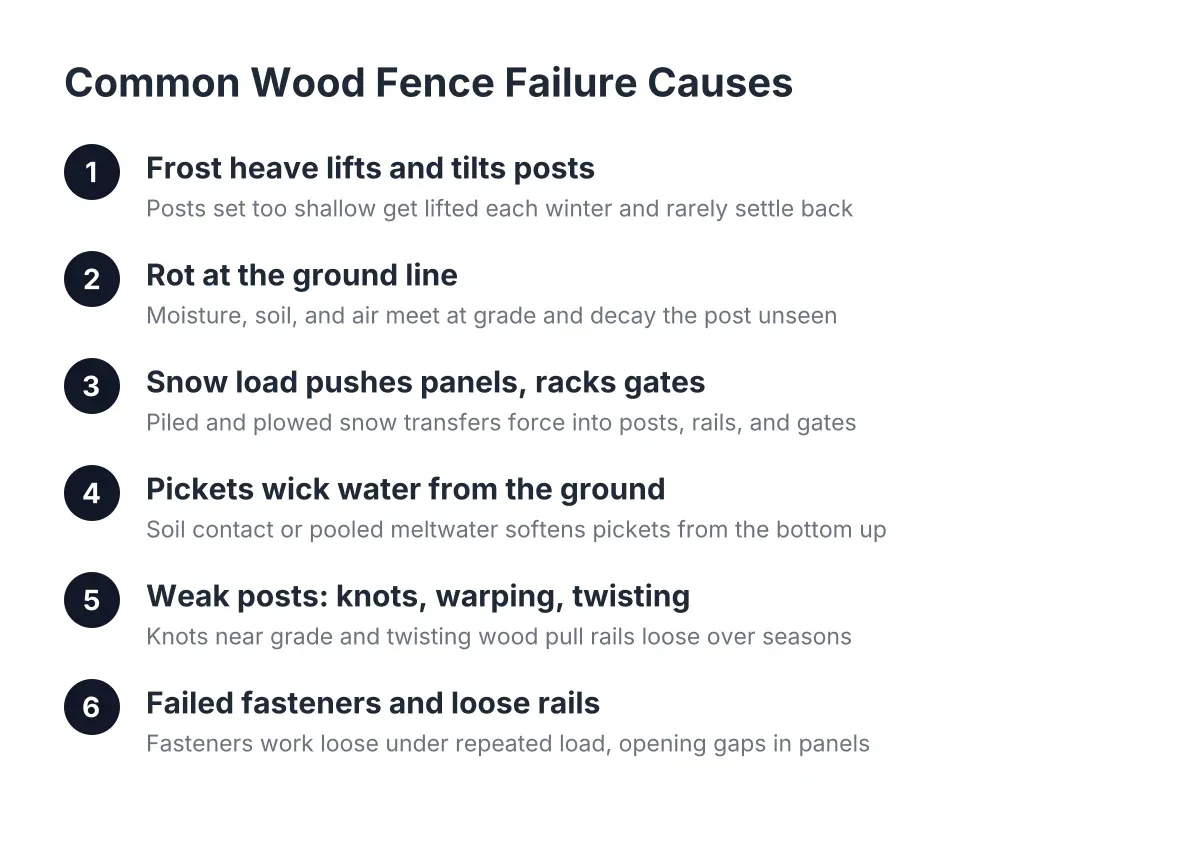
Most wood fences in Alaska do not fail from old age. They fail from a short list of causes that show up again and again: frost heave that lifts posts, rot that starts at the ground line, and snow load that pushes panels until something gives. If you manage several rental properties in Anchorage, or you own acreage out toward Wasilla or Knik-Fairview, you have probably seen all three. Understanding wood fence failure causes is essential to managing these structures effectively. This guide walks through the most common wood fence failures in Alaska, how to spot each one early, and what actually fixes it versus what just buys six months.
Knowing the failure modes matters most at the consideration stage. Whether you are weighing a cedar fence against chain link for a perimeter, or deciding if a leaning fence needs repair or replacement, the right call depends on why it failed in the first place.
1. Frost Heave That Lifts and Tilts Fence Posts
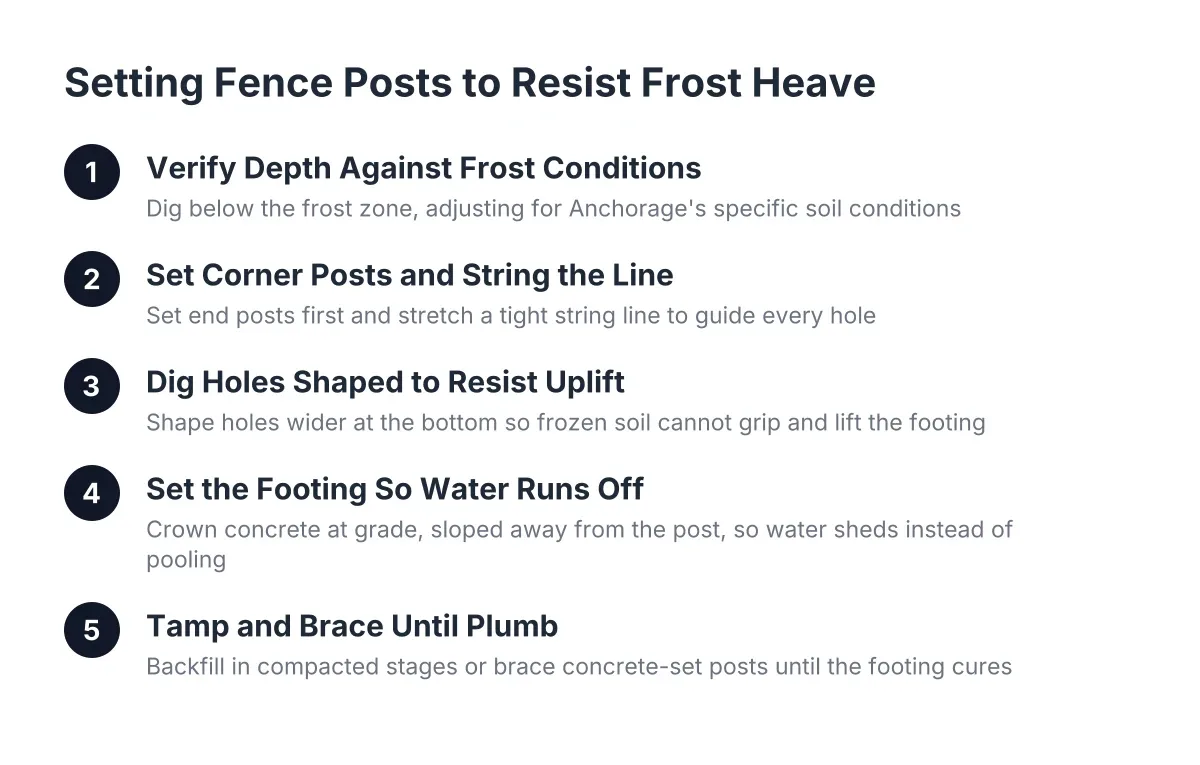
Frost heave is the signature Alaska failure. When the ground freezes, moisture in the soil expands and grips anything buried in it. A post set too shallow, or set with a footing shaped wrong, gets lifted a little each winter and rarely settles back where it started. After a few freeze-thaw cycles, you have a fence line that waves like a snake and gates that no longer latch.
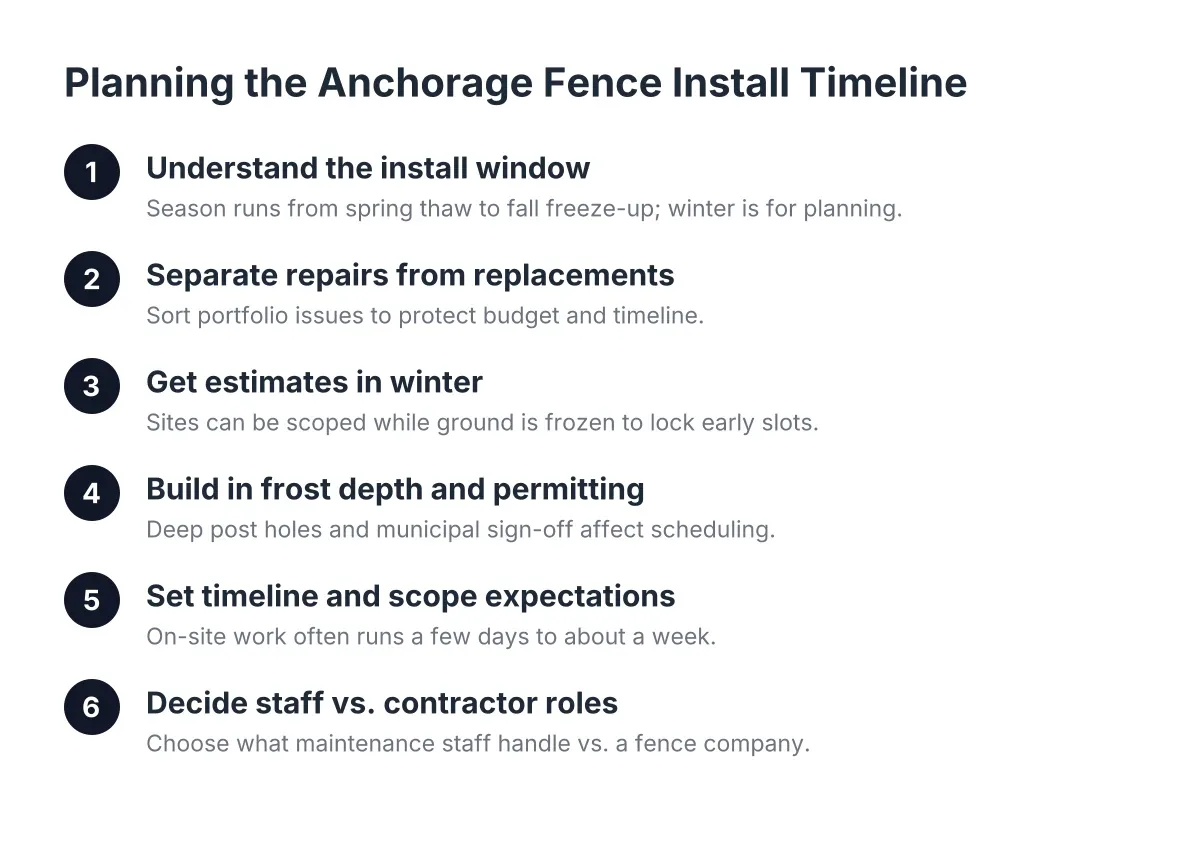
The fix starts at install. Posts need to be set below the local frost line, which in Anchorage is a serious dig. For reference, Anchorage's building code amendment sets the minimum exterior footing depth at 42 inches below finished grade for frost protection, according to PermitsGuide.com. A fence company that works Anchorage ground plans the dig around that reality instead of treating it like a Lower 48 job.
For a property manager, heaved posts are the failure that generates repeat tenant complaints. A handyman who resets the post at the same shallow depth has not fixed anything; the ground will lift it again next winter.
2. Rot at the Ground Line, the Most Common Wood Fence Failure
Ground-line rot kills more wood fence posts than anything else, including posts on fences where the panels were repainted and maintained for years. The panels can look fine while the post quietly decays at the exact point where soil, moisture, and air meet. One heavy windstorm or one winter of snow load against the panels, and the post snaps right at grade.
Two install habits make this worse. First, filling concrete only to an inch or two below grade and topping it with dirt or sod traps moisture right at the post's most stressed point. Second, concrete poured tight against wood can hold water against the post instead of letting it drain. A well-draining backfill detail, or concrete finished to shed water away from the post, makes a real difference in post life.
Check your fence lines each spring by pushing on posts at the top. Movement at the base, soft wood at grade, or a post that flexes more than its neighbors means rot has started, even if everything above ground looks healthy.
3. Common Causes of Wood Fence Failure: Snow Load Pushing Panels and Racking Gates
Anchorage snow does not just sit on top of a fence. It piles against panels, slides off roofs onto fence sections below the eaves, and gets pushed by plows into solid frozen banks along property lines. A privacy fence with solid panels takes that load like a wall, and the force transfers straight into the posts and rails.
The common results are cracked rails, pickets popped off their fasteners, and gates racked out of square so they drag or will not close. On rental properties, a gate that will not latch is also a liability issue, not just a maintenance ticket.
Placement and design are the defenses. Keep fence lines out of roof slide zones where possible, plan plow routes so snow gets pushed away from the fence, and consider semi-private picket spacing in high-drift areas so wind and snow can move through instead of stacking up.
4. Pickets That Wick Water from the Ground
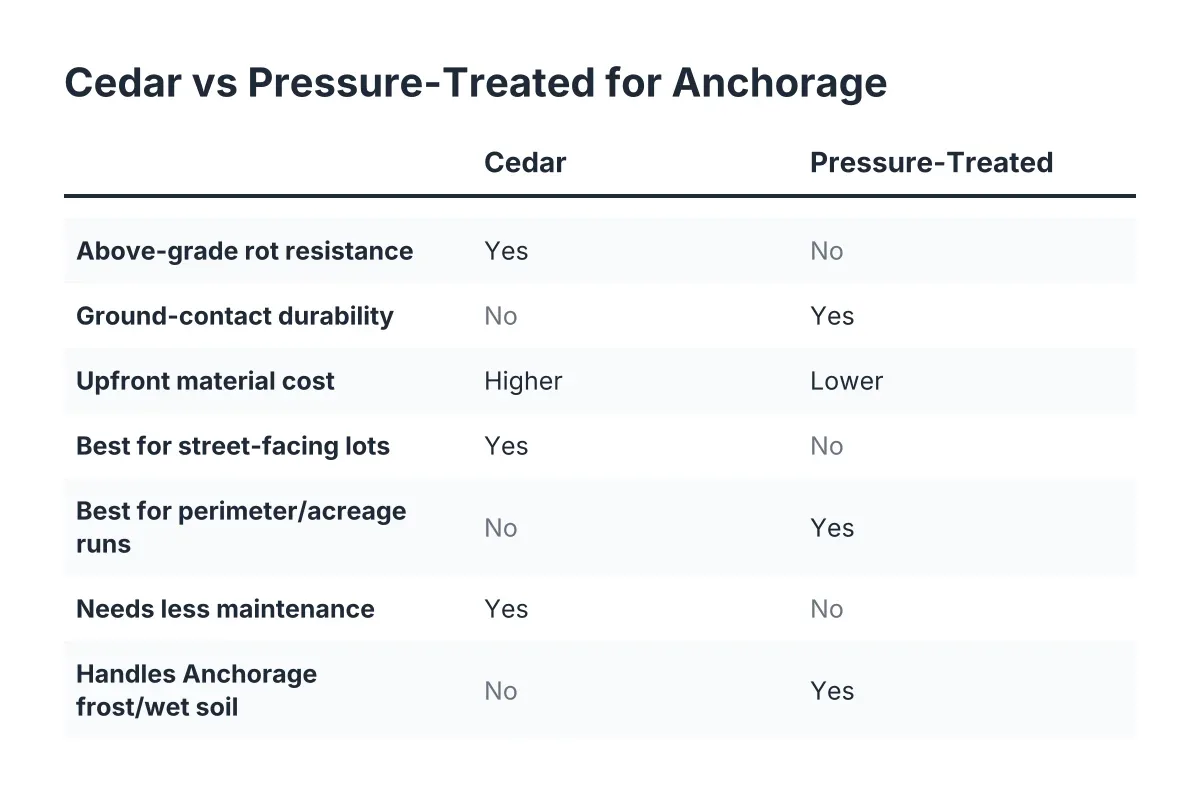
Cedar pickets that touch soil or sit in pooled meltwater pull moisture up like a sponge. The bottom few inches of the fence turn dark, then soft, then fall apart years before the rest of the fence. On flat lots with poor drainage, which describes plenty of Anchorage yards and a lot of acreage in Meadow Lakes, this failure shows up fast.
The standard protection is a pressure-treated rot board run along the bottom of the fence. The treated board takes the ground contact and the standing water, and the cedar pickets sit above it, dry. When the rot board eventually wears out, you replace one sacrificial board instead of an entire fence line of pickets.
If you are getting a fence estimate for a cedar fence, ask whether a rot board is included. Its presence or absence tells you how the installer thinks about moisture, which is the whole game in this climate.
5. Weak Posts: Knots, Warping, and Twisting
Wood posts have failure modes that have nothing to do with the install. A large knot near ground level is a built-in weak point at exactly the spot where wind and snow load put the most stress on the post. Over several seasons, posts can also warp and twist, pulling rails loose and opening gaps between panels.
Material selection at install time matters here. Straight, tight-grained posts without large knots in the bottom third hold up far better. Redwood resists rot naturally and holds its color, but it costs more and is harder to source this far north. Pressure-treated posts trade some looks for durability, which is why many Alaska fences pair treated posts and rails with cedar pickets.
For a large-acreage owner fencing hundreds of linear feet, post quality compounds. One bad post in a backyard fence is an annoyance; multiple weak posts across a pasture line create recurring problems tied to wood fence failure causes.
6. Failed Fasteners and Loose Rails
Freeze-thaw cycles work fasteners loose the same way they heave posts. Nails back out of rails, screws lose their bite in wood that swells and shrinks with the seasons, and brackets corrode where road salt and meltwater splash. The first symptom is usually a rattling panel; the end state is a rail on the ground.
Cheap fasteners are a false economy in Alaska. Hot-dipped galvanized or exterior-rated coated screws cost more per box and save you a spring weekend of re-fastening every year. Ring-shank nails hold better than smooth ones in wood that moves.
Therefore, if you are reviewing a bid for wood fence installation, the fastener spec is worth a question. It is a small line item that predicts how the fence will look in year five.
7. Gates That Sag, Drag, and Freeze Shut
Gates fail first on almost every wood fence. They carry their own weight on hinges all year, they get slammed by tenants and kicked by snow boots, and in winter they freeze to the ground where meltwater pools at the threshold. A sagging gate is usually a hinge-post problem, not a gate problem; the post leans, and the gate follows.
Suppose you manage a twelve-unit complex in Anchorage with three pedestrian gates on the perimeter fence. In that scenario, each gate might see dozens of open-close cycles a day, which is more wear in one winter than a single-family backyard gate sees in five years. Gate installation for that kind of traffic means a heavier hinge post set deep, commercial-grade hardware, and a latch that works with gloves on.
For high-traffic gates, it is worth discussing a metal gate frame hung on steel posts even within a wood fence line. The hybrid costs more upfront and cuts the repeat repair calls.
8. Wood Fence Failure: When Patching Treats the Symptom Instead of the Cause
Plenty of common wood fence failures come back because the repair treated the symptom. A new picket nailed over a rotting rail fails with the rail. A heaved post pounded back down heaves again. Additionally, a sagging gate planed to clear the ground drags again when the hinge post moves another inch.
However, full tear-out is not always the right answer either. When a post rots at ground level but its concrete footing is sound, cutting the post above the rot and setting a new steel post into the existing footing can cost less than removing the whole footing and starting over. That kind of interim fence repair keeps the fence standing and lets the money count toward an eventual full fence replacement.
The decision rule is simple: find out why it failed before paying to fix it. A fence company that diagnoses before quoting saves you the second call.
How to Evaluate a Wood Fence Bid Against These Failures
Use the failure list as a checklist when comparing bids. A thorough fence estimate should address, in writing or in conversation:
- Post depth relative to Anchorage frost conditions, and how footings will be shaped to shed water
- Backfill and concrete detail at the ground line, the most common rot point
- Whether a pressure-treated rot board protects the cedar pickets from ground moisture
- Fastener type and corrosion rating
- Gate post sizing and hardware grade for the expected traffic
- Fence placement relative to roof slide zones and plow paths
Budget context helps too. As of 2026, a wood fence typically costs 20% to 30% more than a comparably sized chain-link fence, according to Angi, which puts similar wood projects in the range of $1,790 to $4,560 versus $1,300 to $3,540 for chain link. For a long perimeter run on acreage, that gap is worth weighing against the privacy and look that only a wood fence provides.
When the Common Failures Point to a Different Fence
Sometimes the honest answer to repeated wood fence failures is a different material. A rental property perimeter that takes constant tenant traffic and plow abuse may do better as a chain link fence with a wood privacy section only where it matters, like around a dumpster enclosure or patio area. A pasture line on twenty acres may not justify wood at all once you price the linear footage.
That trade-off cuts both ways. Chain link will not give you privacy or curb appeal, and an ornamental fence costs more upfront than either. The right call depends on the property, the traffic, and how long you plan to hold it.
One limit worth stating plainly: soil conditions vary lot to lot, especially on undeveloped land outside Anchorage, and drainage or frost behavior on your specific site is something to confirm with a professional before setting posts. A short site visit before the estimate catches problems that no article can predict from a distance.
The pattern across all of these failures is the same. Wood fences in Alaska do not fail randomly; they fail at the ground line, at the posts, and at the gates, and they fail where water and frost were not planned for. Build and repair against those specific points, and a wood fence here earns its full lifespan.
If you need wood fence installation, Anchorage Fence Co can help.
Prefer to talk it through? Call (907) 312-2862 — a quick call is usually the fastest way to get a straight answer for your situation.