The Best Wood Types for Anchorage Fences That Survive Frost Heave
Pick the wrong wood for a fence in Anchorage and the ground will tell you within two winters. Posts lift, pickets cup, gates drag, and you are back on the phone scheduling fence repair you thought you had already paid to avoid. The best wood types for Anchorage's climate are the ones that handle two separate problems at once: constant moisture cycling above the ground and frost heave below it. Most fence failures here trace back to one of those two things, and the wood you choose plays a bigger role than most people expect. Understanding how frost heave affects fence wood is essential in this climate, particularly when dealing with frost heave fence wood challenges.
This guide walks through why Anchorage ground is hard on wood fences, which species hold up, which ones fail early, and how the install itself matters as much as the lumber. It is written for anyone deciding on a wood fence here, whether that is a homeowner finishing a new build or a property manager tired of calling someone back to the same sagging fence line every spring.
Why Anchorage Ground Is Hard on Frost Heave in Fence Wood
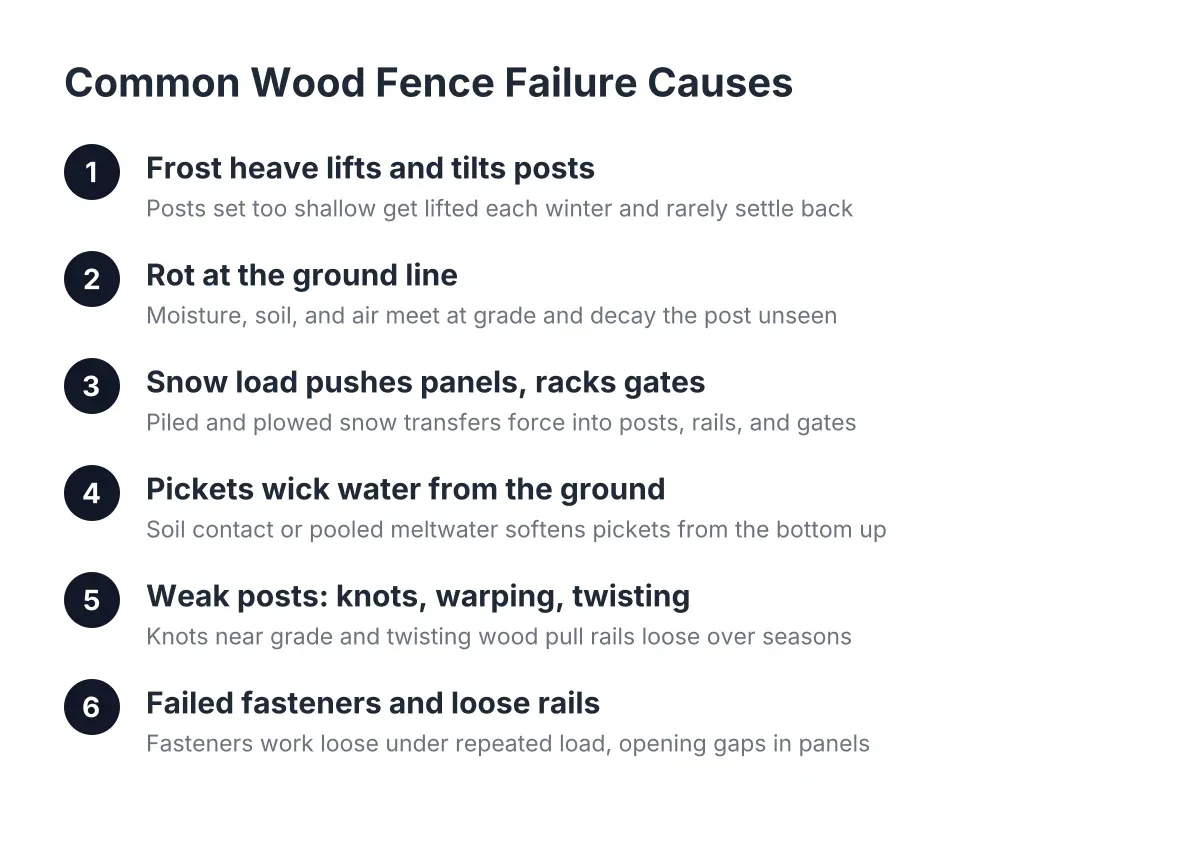
Start with what the fence is standing in. Anchorage sits in a freeze-thaw climate. Water in the soil freezes, expands, and pushes upward on anything buried in it. Then it thaws, the soil settles, and the cycle repeats. A fence post is a long lever stuck in that moving ground. Over enough cycles, frost heave can lift a shallow post inches out of position, and the panels attached to it rack, gap, and sag.
Above the ground, the problem is moisture. Snow piles against the bottom of wood fence panels and sits there for months. When breakup comes, meltwater pools along the fence line. Wood that stays wet rots, and the bottom foot of a fence in Anchorage stays wet longer than almost anywhere in the Lower 48. The combination of frost heave and wood decay at the base creates compounding failures.
Then there is snow load itself. A privacy fence is a solid wall, and months of drifted, settled snow leaning against it puts steady sideways pressure on posts and rails. Wood that has already softened from rot, or a post that has already loosened from heave, gives up under that load. That is why so many fences here fail in March and April rather than in summer.
Therefore, the question is never just "what wood looks good." It is "what wood, set how deep, with what drainage, survives this specific ground." Species choice is the first of those three decisions, so start there.
Wood Types That Survive Frost Heave and Freeze-Thaw in Anchorage
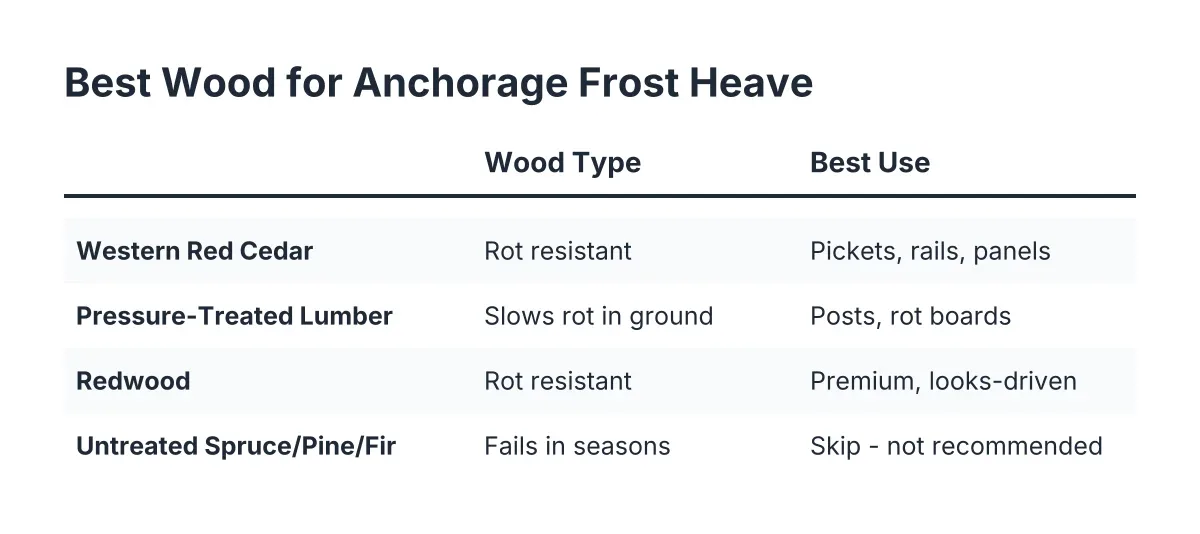
The best wood types for Anchorage fencing are western red cedar for pickets, rails, and panels, and pressure-treated lumber for anything in or near the ground. A few premium species like redwood perform well too, but cedar paired with treated structural members is the combination that balances rot resistance, stability, and cost for most Anchorage fence projects.
Here is how the main options compare.
Western Red Cedar
Cedar is the workhorse of wood fence installation in Anchorage, and for good reason. The wood carries natural oils that resist rot and insects without chemical treatment. It is also dimensionally stable, which matters in a climate that swings from soaked to frozen to dry. Stable wood warps, cups, and twists less when its moisture content changes, so cedar pickets stay flatter and straighter through more seasons than cheaper softwoods.
Cedar also takes stain well and weathers to an even gray if you choose to let it. For a new-build homeowner matching a fence to a fresh exterior, that finish flexibility is a real advantage. The trade-off is cost; cedar runs higher than spruce or pine, and clear, tight-grain cedar costs more than knotty grades. Spend the extra on the pickets people see and the rails that carry load.
Pressure-Treated Lumber
Pressure-treated pine or hem-fir is the standard choice for posts and for the bottom of the fence, where ground contact is unavoidable. The treatment forces preservative deep into the wood, which slows rot in exactly the places Anchorage punishes most: the buried section of the post and the first foot above grade.
One detail worth knowing: a pressure-treated rot board run along the bottom of a cedar fence does a lot of quiet work. It keeps the cedar pickets up out of pooled meltwater so they cannot wick moisture upward. The rot board takes the abuse, and replacing one board years later costs far less than replacing a row of soaked, rotted pickets. On a long fence line at a rental property, that one detail can be the difference between a ten-minute repair and a full section replacement.
Treated lumber has downsides. It arrives wetter than cedar and can warp or twist as it dries, and knots near ground level are weak points right where the post is most stressed. A good installer culls posts with large knots low on the stick before they go in the ground.
Redwood and Other Premium Options
Redwood is naturally rot resistant, holds its color well, and reads as a premium material. However, it ships a long way to reach Alaska, which pushes the price up, and its high tannin content can stain fasteners and concrete if the hardware is not chosen carefully. For most Anchorage projects, redwood is a looks-driven upgrade rather than a performance necessity. Cedar gets you most of the durability at a lower landed cost.
What to Skip
Untreated spruce, pine, or fir pickets are the inexpensive option at the lumberyard and the expensive option over ten years. Without treatment or natural rot resistance, they soak up meltwater, soften at the bottom, and start failing in a handful of seasons. If budget is the controlling factor, a treated-lumber fence or a chain link fence is the smarter cheap option; untreated softwood in Anchorage is a short-term fence wearing a long-term price.
Why Posts Fail First, Even When Panels Look Fine
Fence posts fail before panels do, and that pattern drives everything about how a wood fence should be built in Anchorage. A fence can have clean, freshly stained pickets and still be one wet spring from leaning over, because the posts rot and loosen below grade where nobody sees it. Repainting panels does nothing for a post that is failing at the ground line.
Two forces work on the post. Frost heave pushes it up and loosens it. Moisture rots it right at grade, where water, soil, and oxygen all meet. A post can be sound at the top and sound at the bottom and still snap at the ground line because that narrow band took all the damage.
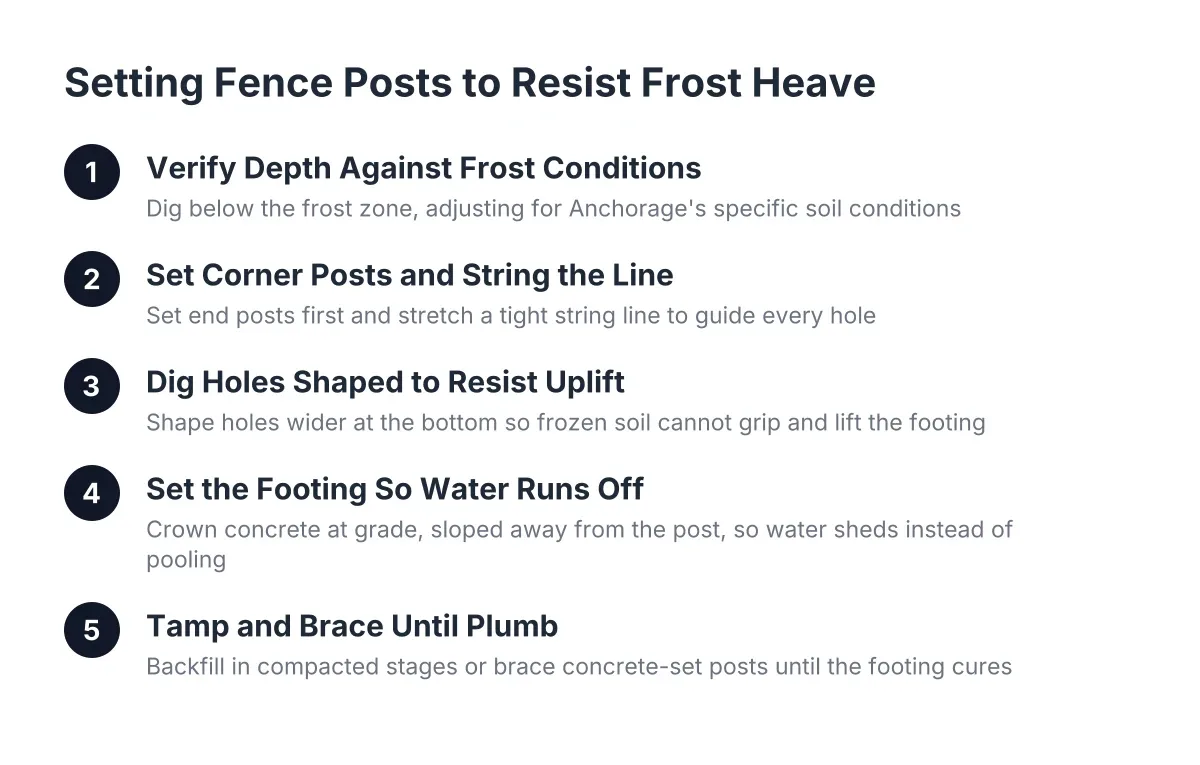
In addition, there is a common misconception worth clearing up. Many people assume concrete around a wood post protects it. Poured wrong, concrete does the opposite; it forms a cup that traps water against the wood and speeds up rot. Well-draining backfill, gravel at the base, concrete crowned to shed water away from the post, and thorough tamping all matter. Loose, poorly compacted backfill is the main reason posts work free under wind and water load, no matter how good the lumber was.
When posts do fail, full removal is not always the first move. Pulling a post and its concrete footing out of Anchorage ground is slow, disruptive work. An interim post repair that preserves the existing footing can keep a fence standing and upright, and the money spent on that repair effectively carries forward toward an eventual full replacement, often with steel posts the second time around. For a property manager weighing a repair request against a capital project, that staged approach keeps the fence functional without forcing the replacement decision early.
Which Wood Holds Up Best Below the Frost Line in Anchorage
Below grade, pressure-treated posts rated for ground contact are the right call in Anchorage, and depth matters as much as species. Anchorage's building code amendment sets the minimum exterior footing depth at 42 inches below finished grade, according to PermitsGuide.com, which gives you a sense of how seriously the municipality treats frost protection. A fence post set shallow sits squarely in the zone where freeze-thaw cycling does its work.
Depth requirements for fences specifically vary by site and project, so treat that figure as context rather than a spec for your fence. The principle holds either way: the deeper the post sits relative to the frost-affected soil, the less the seasonal movement grabs it. Shallow posts heave; deep, well-drained posts stay put.
Soil matters too. Anchorage lots range from older in-town parcels with decades of fill and compacted driveways to newer subdivision lots with disturbed, recently graded soil. Wet, silty soil holds water and heaves hard; gravelly, well-drained soil moves less. The same post detail does not perform the same on both. This is one place where a site visit from a fence company beats any chart, because the right answer depends on what the auger brings up.
A few below-grade practices separate fences that last from fences that lean:
- Use ground-contact rated treated posts, not deck-grade lumber.
- Set posts deep enough for the site, with gravel at the base for drainage.
- Crown any concrete so water sheds away from the post instead of pooling against it.
- Tamp backfill in layers; compaction is what keeps the post tight year after year.
- Reject posts with large knots near the ground line, where stress concentrates.
For tight spots, such as a post butting against a neighbor's existing fence or working around mature tree roots, a reinforced detail helps: a metal pipe core with the wood or a sleeve fitted over it carries the load where a standard post will not fit or hold. These are judgment calls best made on site rather than from a materials list.
A Tale of Two Fence Lines: An Illustrative Scenario
Suppose a property manager takes over a fourplex in East Anchorage with two stretches of wood privacy fence, both about eight years old. The west line was built with cedar pickets, treated ground-contact posts, a treated rot board along the bottom, and posts set deep with tamped, draining backfill. The east line was a budget job: untreated spruce pickets nailed to shallow-set posts with concrete poured flush and cupped around the wood.
By year eight in that scenario, the west line needs a stain refresh and one gate hinge adjusted. The east line has three heaved posts, a bottom rail soft enough to push a screwdriver into, and a lean the tenants have complained about twice. The repair estimate for the east line approaches the cost of fence replacement, because the posts are gone, not just the boards. Same climate, same lot, same years. The difference was wood selection and the first two feet of the install.
That pattern is why the cheapest bid on a wood fence in Anchorage is often the most expensive fence on the property ten years later. Material and install quality are not separate line items; they are the same decision.
Cost, Alternatives, and When Wood Is Not the Answer
Wood costs more than chain link, and it asks more of you over time. According to Angi, installing a wood fence typically costs 20% to 30% more than a comparably sized chain link fence, with chain link averaging $1,300 to $3,540 in total cost against $1,790 to $4,560 for a similar wood fence. Those are national ranges, not Anchorage quotes, and Alaska material freight and short install seasons shift local numbers. Treat them as a sense of scale, and treat any online fence calculator the same way: a starting point for budgeting, not a bid.
For some properties, wood is simply the wrong tool. A property manager fencing a parking perimeter at a twelve-unit building, where the fence takes tenant traffic, plow spray, and zero maintenance attention, is usually better served by commercial-grade chain link or a metal fence on steel posts. Steel posts do not rot, warp, or twist, which are the known failure modes of wood posts over time. Wood earns its premium where appearance and privacy matter: street-facing lines, shared yards, and anywhere a new-build homeowner wants the fence to match the house.
For readers hunting inexpensive privacy fence ideas, the honest version in this climate is a treated-post frame with less expensive pickets or prebuilt wood fence panels, protected by a rot board, rather than cutting corners below grade. Save money on what you can replace board by board. Never save it on the posts.
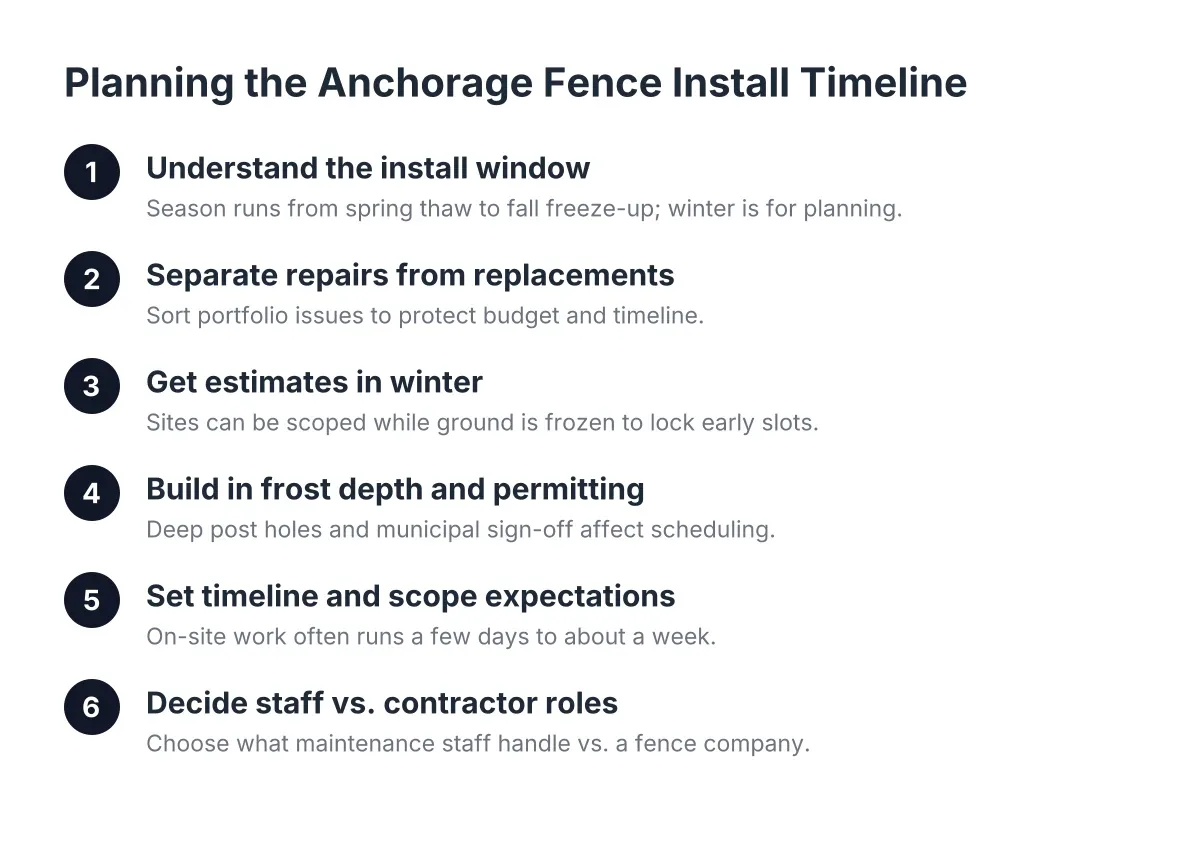
Height and placement carry rules of their own. Anchorage Municipal Code sets front-yard residential fence height limits at 4 feet in most zones, rising to 6 feet, or 8 feet for non-sight-obscuring fencing like chain link, in R-6, R-8, and R-9 districts, according to the Municipality of Anchorage. As of 2026, checking current municipal requirements before setting a layout remains step one of any fence project here, and property line questions are worth resolving before the auger shows up, not after.
Choosing the Best Wood for Your Anchorage Fence to Resist Frost Heave
Here is the short version of the decision, in order:
- Define the job. Privacy fence along a backyard, perimeter containment at a rental, or a decorative line at a new build each point toward different materials.
- Choose the structure first. Ground-contact treated posts, set deep with drainage and real compaction, are non-negotiable for wood fences in this climate.
- Choose the face second. Cedar for looks, stability, and longevity; treated or budget pickets with a rot board where cost controls; redwood only when the premium appearance justifies it.
- Plan for maintenance. Stain or seal on a regular cycle, keep snow from being piled directly against panels where you can, and fix leaning posts early, while a repair is still cheaper than a rebuild.
- Get a site-specific fence estimate. Soil, access, line length, and gate installation needs move the price more than the picket species does.
One honest limitation: no wood fence in Anchorage is maintenance-free, and no species choice eliminates frost heave on a bad site. If your soil is wet, your lot is sloped, or an existing fence is already heaving, bring in a professional before committing to a material. The ground wins every argument it is allowed to have.
Get the species right, get the posts right, and the best wood types for an Anchorage fence stop being a theory and start being a fence that stands straight through breakup, year after year. That is the whole goal: build it once for the ground it actually stands in.
If you need wood fence installation, Anchorage Fence Co can help.
Prefer to talk it through? Call (907) 312-2862 — a quick call is usually the fastest way to get a straight answer for your situation.