Wood Fence Installation Timeline in Anchorage: Planning Around Alaska Winter
If you manage rental properties in Anchorage, the wood fence installation timeline in Anchorage matters as much as the price. A fence that gets scheduled too late in the year sits half-finished under snow until breakup. A fence scheduled right gets dug, set, and built while the ground still cooperates. This guide walks through how long wood fence work takes here, why the calendar in Alaska is tighter than anywhere in the Lower 48, and how a property manager should plan fence projects across a portfolio so tenants stop calling about the same broken sections every spring.
The short version: the build itself is often the fast part. The season, the ground, the permit, and the contractor's backlog are what stretch a one-week job into a three-month wait if you start planning at the wrong time of year.
Why the Timeline in Anchorage Is Different
Anchorage has a real install season. The ground freezes deep, stays frozen for months, and then heaves and softens through breakup. That cycle controls when fence posts can go in the ground, and the posts control everything else.
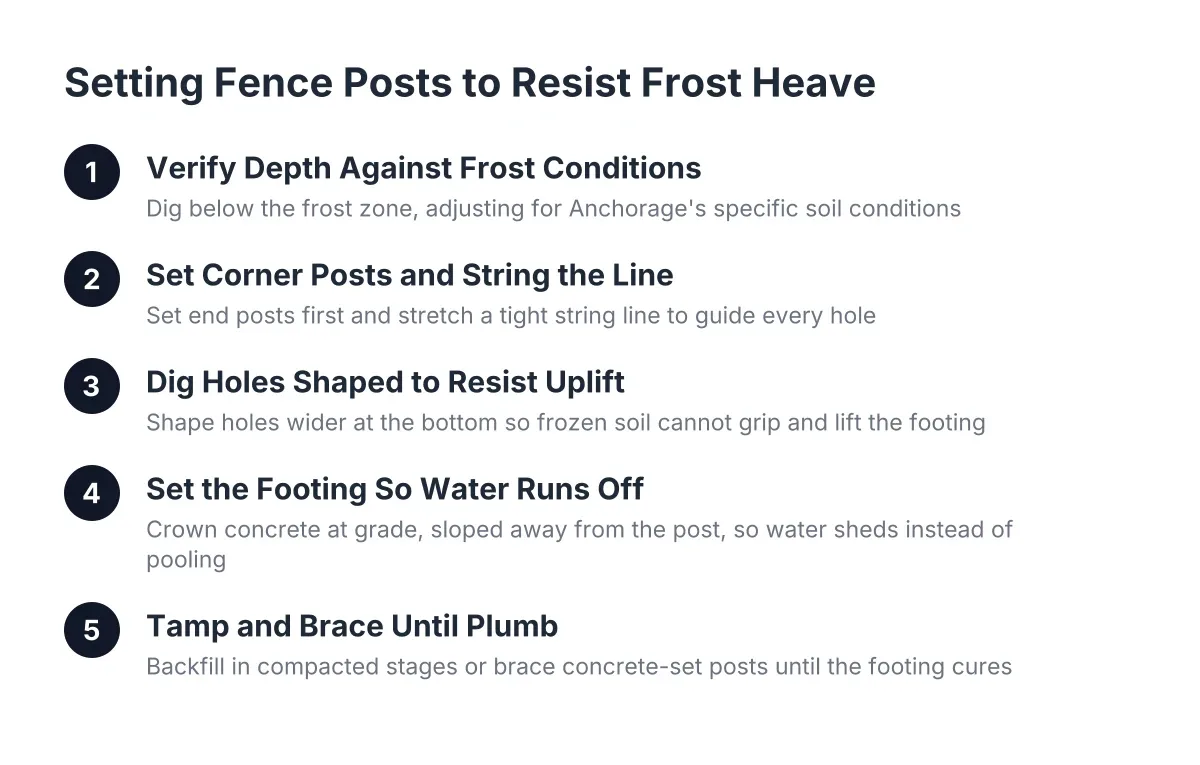
Fence posts need to be set below the depth where frost can grab them. For reference, Anchorage's building code amendment sets the minimum exterior footing depth at 42 inches below finished grade as a frost-protection standard, according to PermitsGuide.com. Fence posts are not footings and are not held to that exact figure, but the number tells you something useful: frost in this ground goes deep, and shallow posts get pushed around by it.
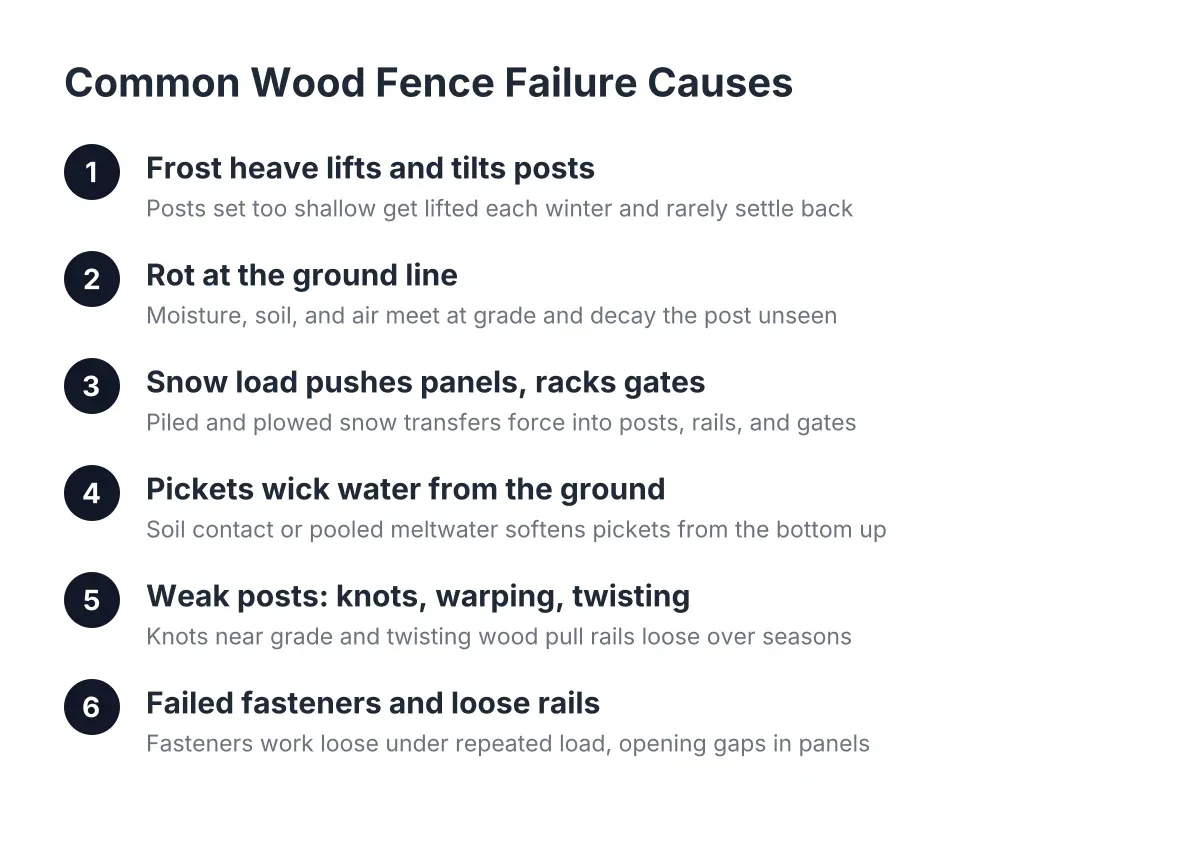
Frost heave is the main enemy of a wood fence here. When water in the soil freezes, it expands and lifts anything it can grip. A post set too shallow, or set in soil that holds water, walks upward a little every winter. After a few seasons the fence line looks like a wave, gates stop latching, and the repair calls start. That is why the digging window, not the carpentry, drives the fence installation timeline in Anchorage.
Snow load matters too. Panels built late in fall face months of plowed and drifted snow leaning against them before the wood has fully settled against its posts. Gates that were never tested through a freeze-thaw cycle are the first thing tenants complain about in January.
How Long Does It Take to Install a Wood Fence?
For a typical residential-scale wood fence, the on-site work usually takes a few days to about a week once the crew starts. Larger jobs, like the perimeter of an apartment complex or a long run between buildings, can take one to three weeks of crew time. The full project, from first site visit to final gate adjustment, often spans four to eight weeks because of estimating, permits, materials, and scheduling.
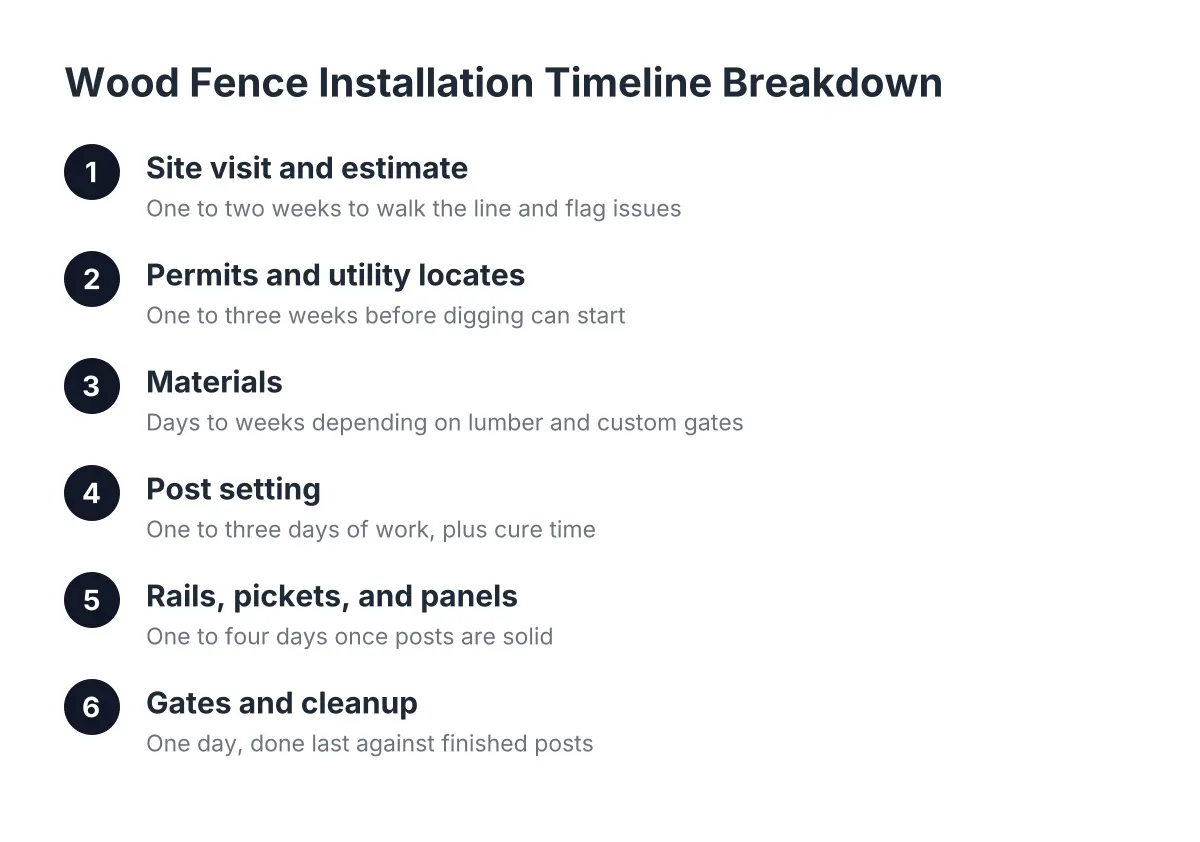
Here is how that time typically breaks down:
- Site visit and fence estimate: one to two weeks. The contractor walks the line, checks grade changes, locates gates, and flags anything unusual like old concrete footings or a shared fence line with a neighboring parcel.
- Permits and utility locates: one to three weeks. Utility locates must happen before anyone digs, and the municipality has rules on fence height and placement. More on both below.
- Materials: days to weeks. Cedar fence lumber and privacy fence panels are usually available, but specific heights, custom gates, or large commercial quantities can add lead time.
- Post setting: one to three days of work, plus cure time. Posts get dug below the frost grab zone and set. If concrete is used, it needs time to cure before panels hang on it.
- Rails, pickets, and panels: one to four days. This is the visible progress, and it goes fast once posts are solid.
- Gates and cleanup: one day. Gate installation comes last so hardware can be set against finished posts and panels.
Those crew-time figures assume decent access and workable ground. A sloped in-town lot with mature trees, buried debris from an old fence, or a tight alley approach slows everything down. So does rock or saturated soil at post depth.
Wood Fence Installation Timeline by Season in Anchorage
Anchorage fence work follows the ground, not the calendar page. Here is how each part of the year affects scheduling, and what a property manager should do in each window.
Spring: Breakup to Early Summer
Spring is when demand spikes. Winter damage shows up as soon as the snow melts: leaning posts, snapped rails, and gates that frost heave pushed out of square. Every property manager in town calls at the same time, so contractor backlogs are longest right as the digging gets possible.
However, early breakup ground can still be frozen or waterlogged at post depth. Crews may be able to demo an old fence and stage materials before they can dig. If you want a spring install, get the estimate and the contract done in late winter so you are at the front of the schedule, not the back.
Summer: The Prime Window
Mid-summer is the easiest time to build a wood fence in Anchorage. The ground is fully thawed, daylight is long, and crews can run full days. Post holes dig clean, concrete cures predictably, and cedar panels go up without weather delays.
The trade-off is that everyone knows this. Summer slots fill early, and a manager who calls in July for an August install may be looking at September or a spot on next year's list. For portfolio work across several properties, summer is when you bundle jobs: one mobilization, several sites, better scheduling leverage with the crew's calendar.
Fall: The Deadline Season
Fall is the last chance to get posts in the ground before freeze-up. Digging gets harder as frost creeps down, and once it sets in, post work stops for the season at most sites. Panels and gates can sometimes be hung on posts that were already set, which is why some contractors split a late job into two phases: posts before freeze-up, panels after.
Therefore, treat early fall as a hard deadline for anything that involves new posts. If a tenant reports a failing perimeter section in September, the decision is simple: fix it now or plan to secure it temporarily and rebuild in spring.
Winter: Planning, Permits, and Repairs
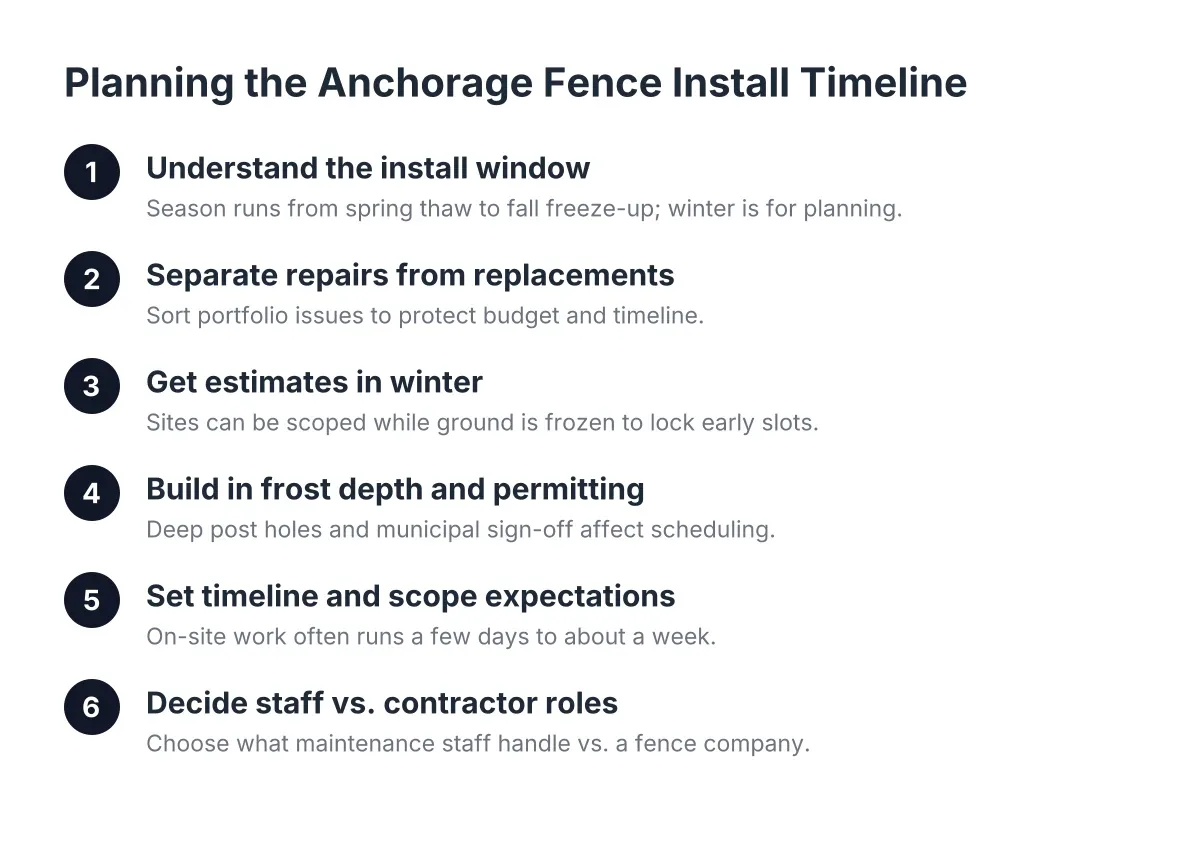
Full fence installation mostly pauses in winter, but the project does not have to. Winter is the best time to walk your properties, list every fence problem, get estimates, lock in contracts, and handle permits. Contractors have time to do thorough site visits, and you get first position on the spring schedule.
Certain fence repair work continues in winter too. Broken pickets, damaged rails, and gate hardware can often be fixed on existing posts without digging. What cannot happen is new post holes in frozen ground without specialized effort that rarely makes sense for a wood fence budget.
What Stretches a Wood Fence Timeline Past the Estimate
Most delays trace back to a handful of causes. Knowing them lets you plan around them instead of discovering them mid-project.
- Utility locates. No one digs until the lines are marked. Build this wait into every schedule.
- Permit and code review. Anchorage Municipal Code sets front-yard residential fence height limits at 4 feet in most zones, rising to 6 feet, or 8 feet for non-sight-obscuring fencing like chain link, in R-6, R-8, and R-9 districts, according to the Municipality of Anchorage. A privacy fence design that ignores those limits gets redesigned, and redesign means delay. Confirm zoning rules for each parcel before the estimate is final.
- Old fence demolition surprises. Tearing out a failed fence goes quickly when rails come off first and panels stack out of the way. Old concrete footings in the post line are the slow part; each one either gets pulled or the new post line shifts.
- Soil conditions at depth. Rock, roots, high water, or lingering frost at post depth turns a one-day dig into three.
- Weather. Early snow, a cold snap during concrete cure, or a soaked site after heavy rain all push the schedule.
- Materials. Standard cedar and privacy fence panels move fast; custom heights and commercial gate hardware can add weeks in 2026 if not ordered early.
In addition, shared property lines deserve a mention. If a fence line borders another owner's parcel or an existing fence, sorting out placement before the crew arrives avoids a mid-job stop. It is also worth knowing that Alaska has no single statewide fence statute covering every situation; most rules come from municipal zoning and, in some areas, HOA covenants, so check both for each property.
A Portfolio Example: Scheduling Three Properties in One Season
Suppose a property manager picks up a new 24-unit complex in midtown Anchorage in October. The walk-through finds a leaning cedar fence along the back lot line, a sagging gate at the dumpster enclosure, and two other properties in the portfolio with smaller wood fence problems tenants have flagged.
In that scenario, the smart sequence looks like this. In October and November, get one fence company to walk all three sites and write a combined scope: full fence replacement on the back lot line, gate installation and hardware at the enclosure, and section repairs at the other two properties. Over winter, handle permits and sign the contract. The gate and picket repairs happen on existing posts in late winter, which quiets the tenant complaints early.
Then, as soon as the ground allows in spring, the crew digs and sets posts for the replacement run. Panels follow within the week. The whole portfolio's fence work closes out by early summer, in one billing relationship, instead of three emergency calls spread across the busy season. Any cost figures for a plan like this depend on length, height, grade, demo, and gate count, which is why the estimate walk matters more than any per-foot number you find online.
That bundled approach is also where the fence installation timeline becomes a management tool rather than a headache. One contractor, one schedule, one invoice stream, and the posts go in during the right ground conditions instead of whenever the complaint lands.
Wood vs. Chain Link: Timeline and Cost Trade-offs
For a property manager, wood is not always the answer, and it is worth weighing honestly. Wood fence installation typically costs 20% to 30% more than a comparably sized chain link fence, averaging around $3,100 more, according to Angi. The same source puts chain link at $1,300 to $3,540 in total cost on average versus $1,790 to $4,560 for a similar wood fence. HomeGuide puts chain link at $10 to $40 per linear foot installed on average. Treat all of these as national reference points, not Anchorage quotes; local fence installation cost depends on your site, and the numbers to trust come from a written fence estimate.
Timeline-wise, chain link usually goes up faster because there are no pickets or panels to build, though the posts face the same frozen-ground calendar. Wood earns its premium where tenants and owners want privacy and appearance: street-facing runs, courtyards, and anything an HOA sees. Chain link makes sense for rear perimeters, storage areas, and anywhere durability per dollar wins.
One more trade-off worth knowing: wood posts are the weak point of a wood fence over time. Posts rot, warp, and twist even when the panels above them get repainted and maintained. Some repair approaches preserve the existing concrete footings so an interim fix keeps the fence standing now, and that work carries forward toward an eventual rebuild with steel posts. For a portfolio, that kind of phased thinking keeps annual costs predictable instead of lumpy.
Also budget for upkeep. A cedar fence in Anchorage needs periodic staining or sealing, and spring inspections after each winter catch heaved posts and loosened hardware while they are still cheap fixes.
How to Keep Your Wood Fence Installation Timeline on Track
The projects that finish on time share the same habits. Most of them happen before a shovel touches ground.
- Start one season early. Estimate in winter for a spring build; estimate in spring for a summer build. Searching for wood fence installation near me in July is how you end up on next year's list.
- Walk every property before the estimate. List every fence issue, not just the one a tenant reported, so the scope is complete the first time.
- Confirm zoning and HOA rules per parcel. Height limits and placement rules vary; a redesign mid-permit costs weeks.
- Decide gates early. Gate hardware and commercial-grade latches are common long-lead items.
- Respect the fall cutoff. Posts before freeze-up or wait for spring. There is no good third option for wood.
- Ask how the crew sequences cut panels. On runs with partial sections, a careful installer puts full panels where people see them and cut sections in low-visibility spots, which is a cheap signal of overall workmanship.
- Get billing and documentation terms in writing. For property management paperwork, confirm invoicing terms and insurance documentation before work starts, not after.
One honest caveat: no contractor controls the weather or the ground. A fence company can hold its part of the schedule, but an early freeze or a wet breakup moves dates for everyone. The managers who handle this best build slack into tenant communication, promising a season rather than a date until posts are in the ground.
Sites with steep grades, suspected buried utilities beyond the standard locates, or soils with known heave history deserve a professional assessment before you commit to a layout; those are not conditions to judge from a desk.
The Bottom Line for Anchorage Property Managers
The crew time for a wood fence is measured in days. The real timeline is measured in seasons, and in Anchorage the season is short. Posts need thawed ground and depth below the frost's grip, permits and locates come first, and spring demand rewards whoever planned in winter.
Treat fence work like the capital item it is. Inventory problems in fall, contract in winter, dig in spring or summer, and bundle sites where you can. Do that, and the fence line stops being a recurring tenant complaint and becomes one more system on the property that just works.
If you need fence installation in Anchorage, AK, Anchorage Fence Co can help.
Prefer to talk it through? Call (907) 312-2862 — a quick call is usually the fastest way to get a straight answer for your situation.