How a Corrugated Metal Fence Handles Freeze-Thaw Cycles in Anchorage Winters
If your wood fence just leaned over after another freeze-thaw cycle, you are not alone, and you are not stuck with wood. Understanding how a corrugated metal fence handles freeze-thaw cycles in Anchorage can change what you build next. The short version: the panels themselves shrug off our winters, but the posts and footings decide whether the fence stands straight in April or heaves out of the ground like the old one did. This guide walks through the planning steps in order, so you know what matters before you dig a single hole or call a fence company. Freeze-thaw fence durability depends almost entirely on how deep the posts are set and how well the footings handle our winters.
Step 1: Understand What Freeze-Thaw Actually Does to a Fence
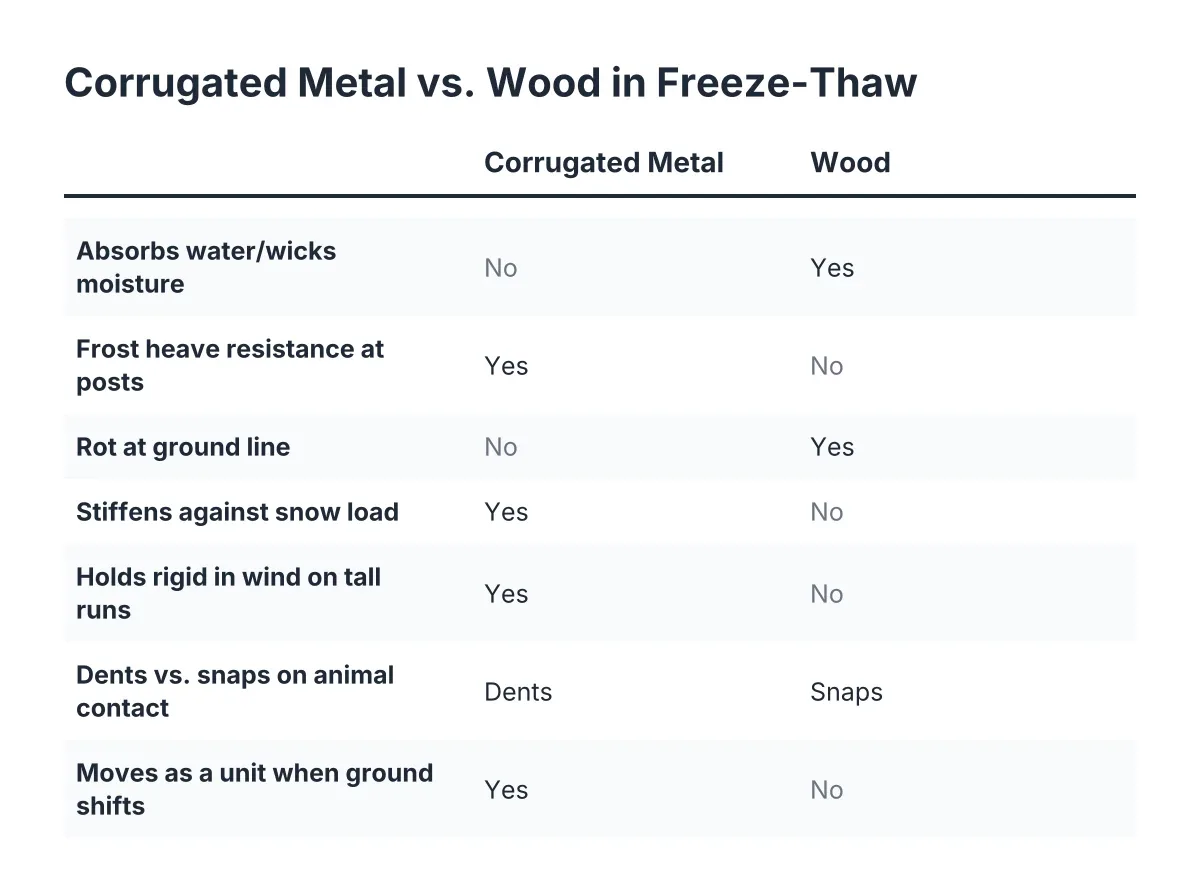
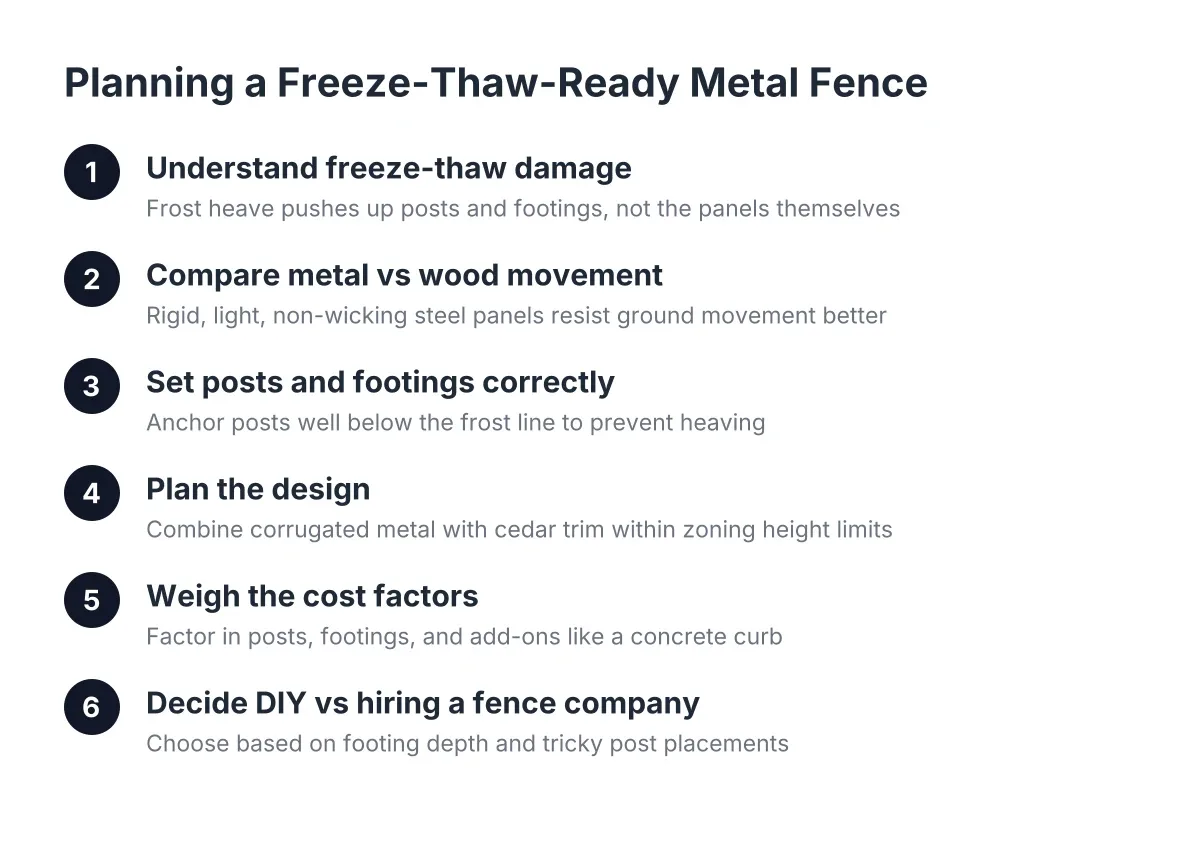
Freeze-thaw damage starts in the ground, not the panels. When water in the soil freezes, it expands and pushes upward on anything buried in it. When it thaws, the soil settles back down. Repeat that cycle every fall and spring, and fence posts slowly ratchet upward or tilt. That is frost heave, and it is why so many Anchorage fences lean by their fifth winter.
Wood takes a double hit. The posts absorb moisture, which feeds rot at the ground line. Then the heaving loosens the footing around a post that is already weakening. Many older in-town fences fail this way even when the owner kept the panels painted and maintained; the posts rot and heave while the boards above still look fine.
Corrugated steel panels do not absorb water, swell, warp, or rot. However, the panels are only as good as what holds them up. That is the whole game in Anchorage, and it is why the next two steps matter more than panel shopping.
Step 2: Learn How Corrugated Metal Fence Handles Movement Better Than Wood
A corrugated metal fence handles ground movement well for three reasons: the panels are rigid, they are light for their strength, and they fasten to a frame instead of resting in the dirt. The ribbed profile that gives corrugated steel its look also gives it stiffness. A panel that resists flexing spreads stress across the whole frame instead of cracking at one fastener.
Weight matters more than most homeowners expect. A lighter panel puts less load on each post, so when frost pushes on a footing, there is less mass working against it. Compare that to a waterlogged cedar privacy panel in March, which can weigh considerably more than it did in August.
In addition, steel does not wick moisture. A cedar fence picket sitting near pooled snowmelt pulls water up into the wood, which is why experienced builders add a pressure-treated rot board along the bottom of a wood fence. Corrugated steel skips that failure mode entirely. Snowbanks can sit against the panels all winter without the material degrading.
One honest trade-off: steel panels catch wind like a sail, more than chain link ever will. A solid metal fence needs posts set deeper and framed stiffer than an open fence of the same height. The panel survives the winter; a shallow post does not.
Step 3: Get the Posts and Footings Right, Because That Is Where Fences Fail
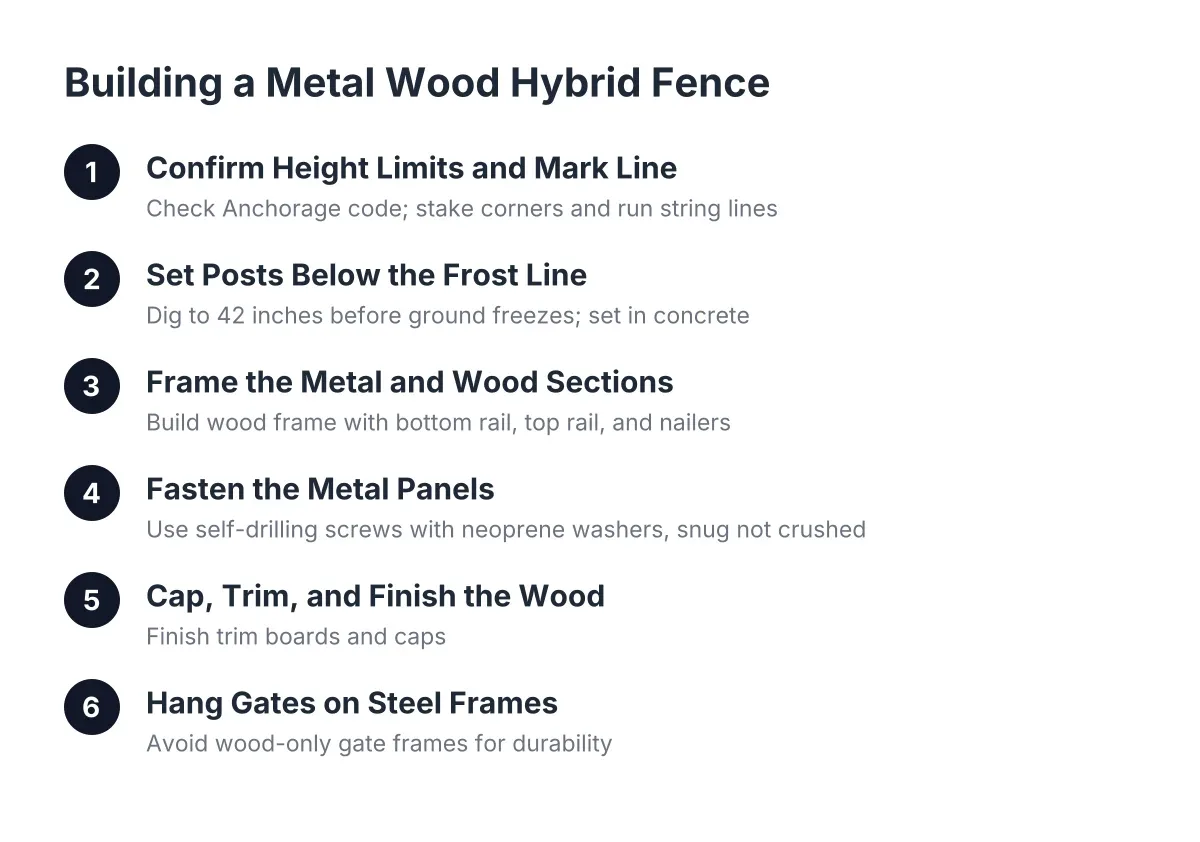
The panels will outlast the posts if the posts are set wrong. In Anchorage, footing depth is not a guess. For context, the municipality's building code amendment sets the minimum exterior footing depth at 42 inches below finished grade for frost protection, according to PermitsGuide.com. Fence posts are not foundations, but that figure tells you how deep the frost problem runs here. A post set shallow will heave; the question is when, not if. With freeze-thaw cycles driving annual soil movement, fence posts must be anchored well below the frost line to maintain durability.
Steel posts beat wood posts in this climate for the same reason steel panels beat wood panels. Wood posts warp, twist, and rot over time. Steel posts hold their shape and their footing. Pairing corrugated panels with steel posts gives you a fence where every structural piece ignores moisture.
For tight spots, there are workarounds a good crew knows. For example, when a fence butts against a neighbor's fence or wraps around a mature tree, a reinforced post built from a metal pipe with a sleeve over it can carry the load where a standard post will not fit. In addition, if your old fence used tall steel posts, reusing them alongside new posts between them can make the rebuilt fence stiffer against wind than a brand-new fence of the same height.
If your dog digs, or the neighborhood rabbits do, a continuous concrete curb poured along the base of the fence closes the gap under the panels and stops the digging for good. That is usually priced as an add-on, so ask for it in the fence estimate rather than assuming it is included.
Step 4: Plan the Design, Including the Corrugated Metal and Wood Combination
Most Anchorage homeowners building new do not want a wall of bare steel. The popular move in 2026 is a corrugated metal and wood combination: steel panels framed in cedar rails and posts wrapped in cedar trim. You get the freeze-thaw durability where the fence meets snow and soil, with warm wood where your eye lands. It suits new builds and renovations where the fence needs to match modern siding and trim.
Height and placement rules apply before design does. Anchorage Municipal Code limits front-yard residential fences to 4 feet in most zones, rising to 6 feet, or 8 feet for non-sight-obscuring fencing like chain link, in R-6, R-8, and R-9 districts, according to the Municipality of Anchorage. A solid corrugated metal fence is sight-obscuring, so check your zone before you design a tall front run.
Design choices that affect winter performance, roughly in order of importance:
- Panel orientation: horizontal ribs read modern and shed snow differently than vertical ribs; either works if framed stiff.
- Frame material: steel posts with cedar rails split the difference between durability and looks.
- Bottom detail: a rot board or concrete curb keeps panels out of standing snowmelt.
- Gate framing: gates sag first, so a welded or cross-braced steel gate frame earns its cost. Gate installation is where corners get cut, and where you notice it every day.
Step 5: Weigh the Cost Factors Honestly
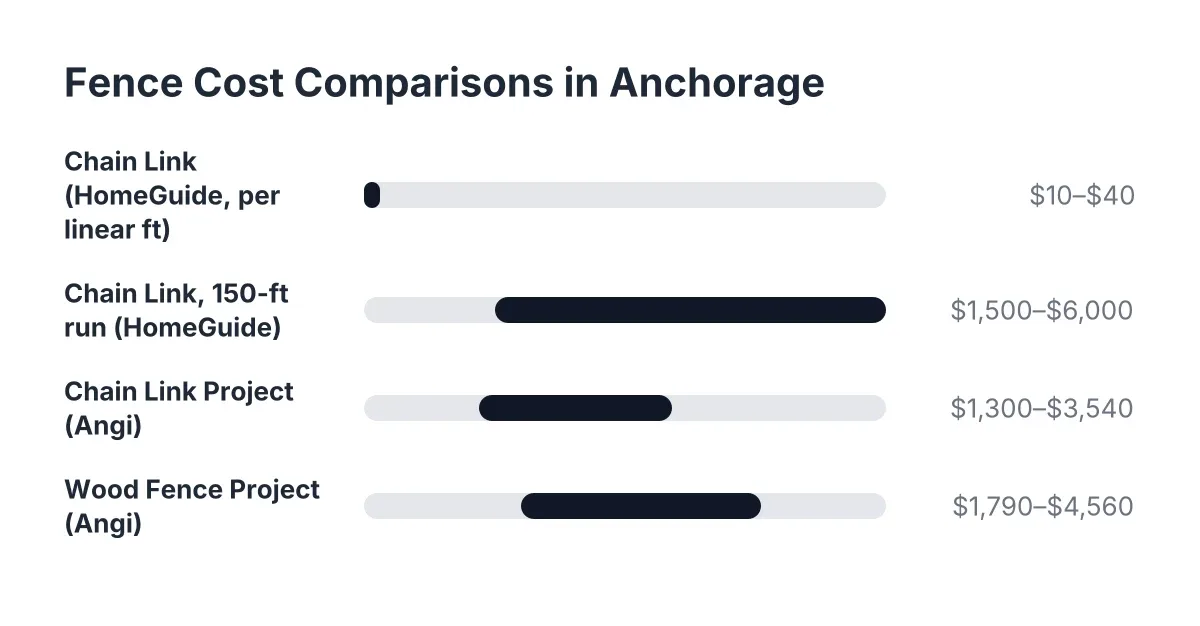
Corrugated metal sits above chain link and near or above cedar in cost, depending on design. For a baseline comparison, chain link runs about $10 to $40 per linear foot installed, roughly $1,500 to $6,000 for a 150-foot run, according to HomeGuide. Angi puts typical chain link totals at $1,300 to $3,540, versus $1,790 to $4,560 for a comparable wood fence. Corrugated metal fence cost depends on panel gauge, frame material, footing depth, gate count, and whether you add wood trim, so treat any figure as a range to discuss, not a quote.
Suppose a homeowner in a newer south Anchorage subdivision just closed on a bare lot and wants about 150 feet of corrugated metal and wood privacy fence plus one gate before the landscaper hydroseeds. In that scenario, the big cost swings are footing depth, steel versus wood posts, and the cedar trim package, and the smart move is pricing the steel-post version first since it is the piece you cannot upgrade later.
Timeline matters as much as price here. Posts need to go in before the ground freezes, so the install season is shorter than the calendar suggests. If your builder hands off exterior work in late summer, get the fence scope settled early; fall is when every fence company's schedule tightens.
Step 6: Decide What to DIY and When to Call a Fence Company
Honest split: homeowners can handle panel swaps, you should not freelance the footings. Replacing a damaged panel on an existing, sound frame is a wrench-and-driver job. Setting posts below frost depth in Anchorage soil, framing a solid panel against wind and snow load, and hanging a gate that still latches in February is professional work.
Call a pro now, not next season, if you see any of these:
- A post that heaved upward or leans more each spring; the footing is failing, and patching the panel wastes money.
- A gate that drags or will not latch after a freeze; that is frame or post movement, not a hinge problem.
- Storm damage that flattened a section; a straight assessment tells you whether it is a repair or a section replacement, and an older fence with sound footings often earns a repair that preserves those footings for a future rebuild.
A fair fence estimate should break out post material, footing depth, panel gauge, gates, and any bottom-of-fence detail as separate line items. If a quote is one lump number, you cannot compare it to anything. Two questions worth asking any provider: how deep do you set posts for a solid panel fence here, and what do you do differently for a fence that takes plowed snow against it? Clear answers to both tell you more than any brochure. If your property has steep grade, soft or disturbed fill, or a disputed property line, bring in a professional before finalizing the layout; those conditions change the footing plan.
How Freeze-Thaw Affects Fence Durability Over Time
Corrugated steel is one of the few fence materials that treats an Anchorage winter as a non-event, provided the posts are set for our ground. The panels handle snow load, snowmelt, and temperature swings without rotting, warping, or loosening. Get the footings below frost depth, frame for wind, detail the bottom edge, and the fence that goes in this summer stands straight through many springs.
If you are planning a new fence, replacing one that heaved, or scrambling after a storm knocked a section flat, Anchorage Fence Co can walk the line with you, give a straight answer on repair versus replacement, and put together a clear fence estimate built for Anchorage ground. Reach out to get on the schedule before the install season closes.
If you need fence installation, Anchorage Fence Co can help.
Prefer to talk it through? Call (907) 312-2862 — a quick call is usually the fastest way to get a straight answer for your situation.