Why Corrugated Metal Fencing Resists Freeze-Thaw Damage in Anchorage, AK
Every spring in Anchorage, fences tell on themselves. Wood posts lean, rails pop loose, and panels that looked fine in October now sag toward the driveway. The ground did that, not the weather alone. Freeze-thaw cycles move soil, and soil moves fences. The reason corrugated metal fencing resists that cycle better than most alternatives comes down to how the material handles moisture, movement, and weight. This guide explains the mechanics in plain terms, compares metal against wood and vinyl under Alaska conditions, and walks through what happens when snow load fence damage occurs and what a project looks like when you are ready to decide.
If you are reading this because snow load flattened a section last winter, or spring thaw heaved a post out of plumb, you are the exact person this material was built for. The same goes for acreage owners out toward Knik-Fairview or Meadow Lakes who need long runs of fence that do not demand yearly repair.
What Freeze-Thaw Cycles Actually Do to a Fence
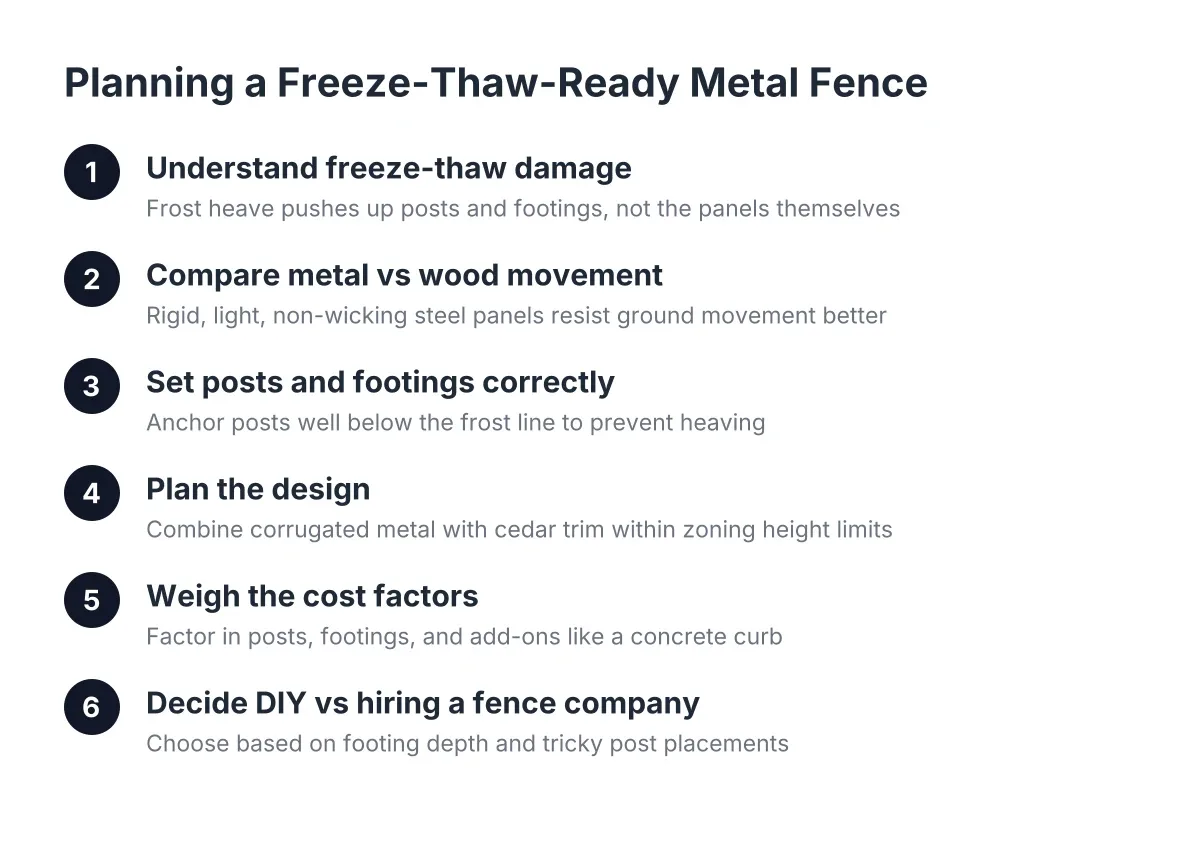
Anchorage ground does not stay still. Water in the soil freezes, expands, and pushes upward on anything buried in it. Then it thaws, the soil settles, and the cycle repeats. Over a winter, that push-and-settle action can lift fence posts, tilt footings, and open gaps at the bottom of panels.
Frost heave is the name for that upward push. It is strongest where soil holds water, which describes plenty of lots in town and even more undeveloped acreage in the Valley. A post set too shallow rides up a little each winter until it leans. A footing poured without drainage in mind can get gripped by frozen soil and lifted like a handle.
The fence material above the ground matters too. Wood absorbs water through end grain and ground contact. When that water freezes inside the wood, it splits fibers, loosens fasteners, and starts rot the following summer. Vinyl does not rot, but it gets brittle in deep cold, and a snow-loaded panel can crack instead of flexing.
Metal behaves differently, and that difference is the whole argument for this fence style in Alaska.
How Corrugated Metal Fencing Resists Frost, Moisture, and Snow Load Fence Damage
Corrugated metal fencing resists freeze-thaw damage for a simple reason: steel does not absorb water. There is nothing for ice to expand inside. The panel sheds snowmelt, rain, and splashback instead of soaking it up, so the repeated freeze-and-thaw that destroys wood fibers has no grip on the material itself.
That is the short answer. The longer answer has three parts worth understanding before you spend money.
The panels do not wick, swell, or split
A cedar fence picket in contact with wet ground pulls moisture upward like a straw. That wicking is why the bottom few inches of a wood fence fail first. Galvanized or coated corrugated steel has no grain and no pores. Meltwater sits against it, freezes, thaws, and runs off. The panel does not care.
In addition, the ridged profile of a corrugated panel adds stiffness without adding weight. A flat sheet of the same gauge would flex and oil-can in wind. The corrugation acts like a built-in rib, which matters when heavy, wet snow slides off a roof and piles against the fence line, risking snow load fence damage that fractures wood fasteners and panels.
Steel posts ride out ground movement better than wood
Posts are where most Anchorage fences actually fail. A wood post can be perfectly sound above grade and rotted to punk below it, because concrete backfill can trap moisture against the wood and speed up rot rather than prevent it. Steel posts do not have that failure mode. Set at proper depth below the frost line with a footing shaped to shed heave forces, a steel post stays where the crew put it.
Here is the practical payoff: when the ground does move, a steel-post metal fence tends to move as a unit and settle back. A wood fence moves unevenly, because each post rots and heaves on its own schedule. One leaning post pulls rails out of square, and the damage spreads panel by panel.
Snow load and fence damage: Why metal sheds what wood breaks under
Snow load is the quiet fence killer in Anchorage. Berms from plowing, drifts against a windbreak line, and the heavy spring snow that sits for weeks all push sideways on panels. Wood pickets pop their nails. Vinyl panels bow and crack in the cold. A properly framed corrugated panel flexes slightly and sheds the load down its ridges.
However, no fence is immune. A plow operator who pushes a full berm directly into any fence can damage it, metal included. The advantage is that metal usually survives what flattens wood, and when it does take a hit, the fix is often one panel, not a whole rebuilt section.
Where Corrugated Metal Fencing Resists the Most Common Anchorage Failures
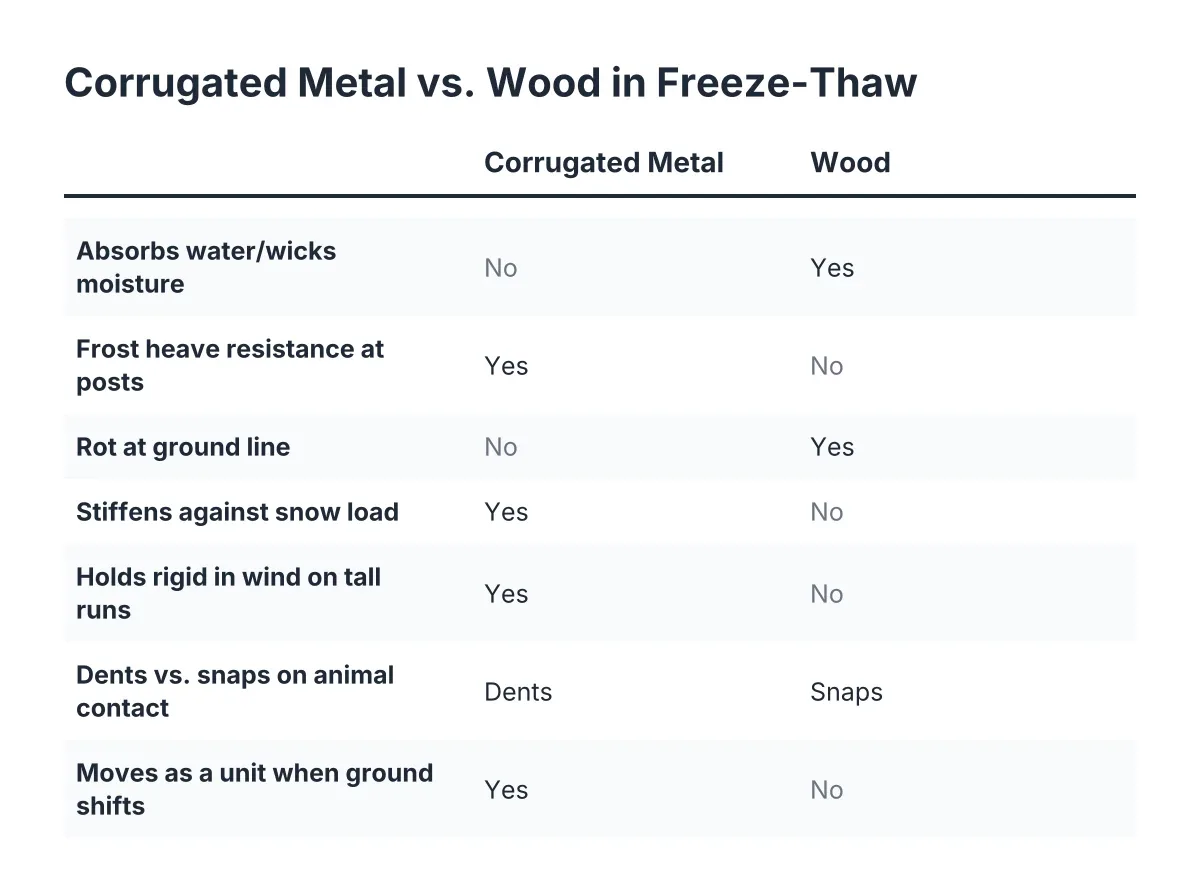
Corrugated metal fencing resists the specific failure modes Anchorage fence owners call about most: heaved posts after spring thaw, rot at the ground line, panels flattened by snow load, and sections knocked loose by wind or a falling branch. It does not eliminate those risks, but it removes the material weaknesses that make wood and vinyl fail first.
Match the failure to the material and the pattern is clear:
- Frost heave at the posts: steel posts set below frost depth resist lift; wood posts rot where concrete traps moisture, then heave and lean.
- Rot at the ground line: steel has nothing to rot; cedar needs a pressure-treated rot board at the bottom to keep pickets from wicking up pooled water.
- Snow load against panels: corrugated ridges stiffen the panel; flat wood pickets rack and pull fasteners.
- Wind on tall fence runs: steel framing holds a tall fence rigid; a tall wood fence catches wind like a sail and works its posts loose.
- Moose and animal contact: a steel panel dents and stays standing; wood pickets snap and leave a gap your dog finds by morning.
For the storm-damage crowd, that last line matters most. Suppose a homeowner in South Anchorage wakes up after a heavy March dump to find two cedar panels flat on the ground and a dog eyeing the gap. In that scenario, the repair conversation is about replacing rotted posts and splintered pickets, and the same thing can happen again next winter. If those panels had been corrugated steel on steel posts, the likely outcome is a dented panel still standing, fixed by swapping one sheet.
Corrugated Metal vs. Wood, Chain Link, and Vinyl in Freeze-Thaw Country
Each fence type has a place, and an honest fence company will tell you that. Here is how the main options compare when the deciding factor is Alaska ground and weather.
Cedar and wood fences
A cedar fence wins on warmth and looks, and good building practices stretch its life: a pressure-treated rot board along the bottom, posts set deep, and drainage-minded footings. Even so, wood posts remain prone to warping, twisting, and rot over time. Repainting the panels does not save a post that is failing below grade. Expect maintenance, and expect the freeze-thaw cycle to find the weakest post eventually.
Chain link fences
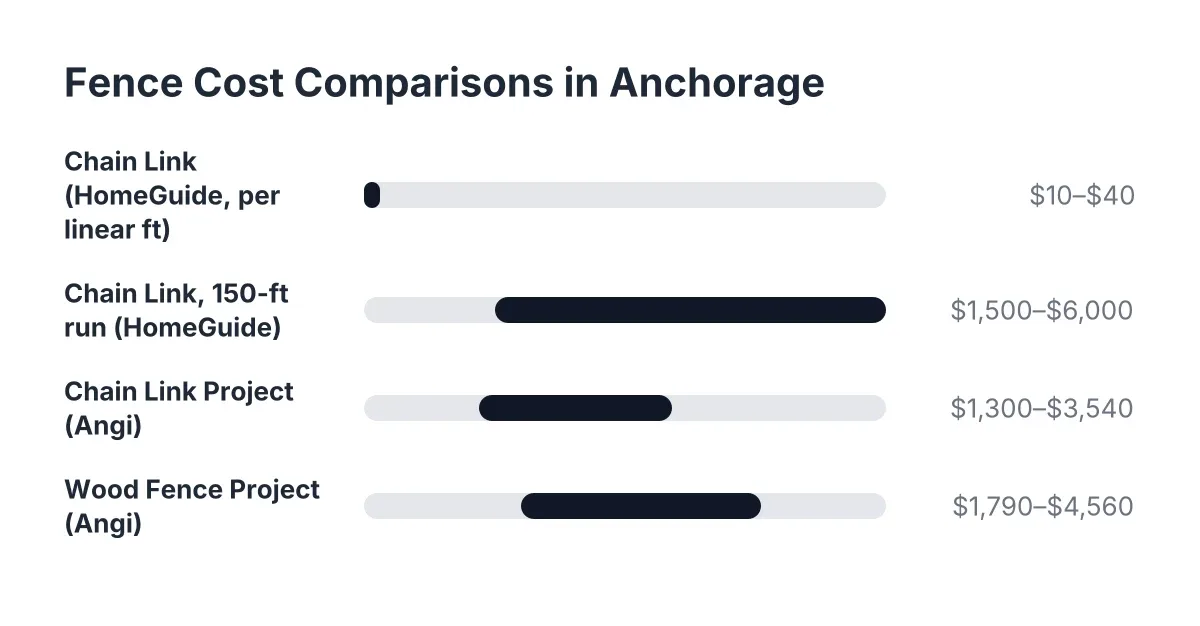
Chain link handles frost country well for the same reason corrugated metal does: steel posts and no material that absorbs water. It is also the budget option. According to Angi, chain link fencing averages $1,300 to $3,540 in total cost, compared to $1,790 to $4,560 for a wood fence of similar size. For acreage owners fencing long runs for animals or property lines, chain link often wins on cost per foot. What it does not give you is privacy or wind screening, which is where corrugated panels earn their price.
Vinyl fences
Vinyl resists rot and fading better than wood, which is its honest selling point. However, it is still PVC. It gets brittle in deep cold, can crack under snow load, and can burn in extreme conditions such as a wildfire, which matters to rural owners with wooded parcels. In tough spots, installers reinforce vinyl posts by sleeving them over a metal pipe, which is a quiet admission of where the strength actually comes from.
The hybrid option: corrugated metal and wood together
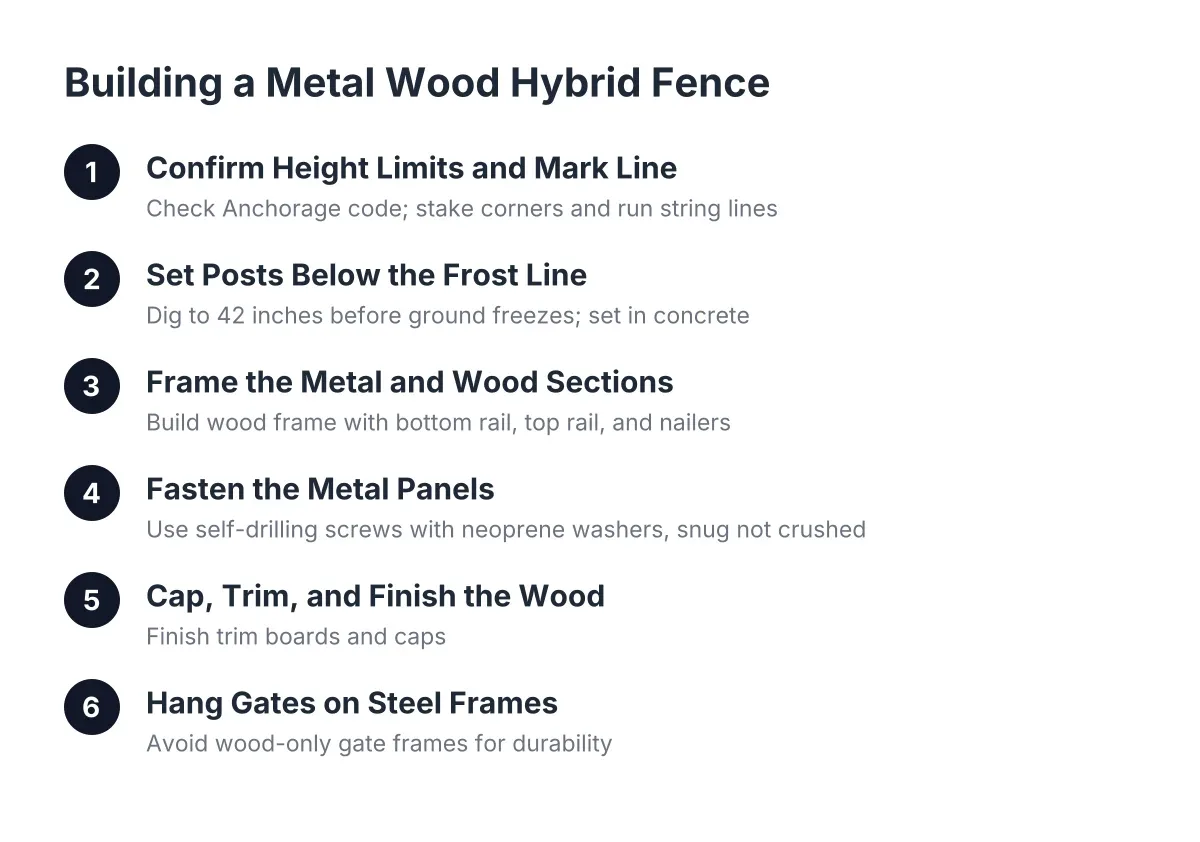
Plenty of Anchorage homeowners land on a corrugated metal fence with a cedar frame: steel panels for the field of the fence, wood posts and rails for warmth, often with a cedar cap and trim. You get the moisture resistance of steel across most of the surface and the look of wood where your eye lands. The trade-off is that the wood frame still needs the same protection any wood fence does, including deep-set posts and a detail that keeps ground moisture away from the lumber. Many builds solve this by running steel posts and wrapping or facing them in cedar, so the structure is metal and the finish is wood.
What a Corrugated Metal Fence Costs in Anchorage: The Factors That Move the Number
There is no single honest price for this fence without seeing the property, but the cost factors are predictable. As of 2026, plan your budget around these variables rather than a national average:
- Linear footage. Acreage runs in Knik-Fairview or Wasilla price differently per foot than a 60-foot backyard section in town, because mobilization spreads across more fence.
- Panel gauge and coating. Thicker steel and better galvanizing or paint systems cost more and last longer against splashback and snow contact.
- Post material and depth. Steel posts set below frost depth cost more to install than shallow-set wood, and they are the main reason the fence stays plumb.
- Framing style. Pure metal framing is the economical build; a cedar-wrapped hybrid adds lumber and labor.
- Ground conditions. Rocky soil, roots, old footings, and wet ground change dig time. Leaving sound old concrete footings in place along a line can even add stability, but working around them takes planning.
- Gates. Gate installation is its own line item, and gates take the most abuse from snow and daily use.
- Height and permits. Anchorage Municipal Code sets front-yard residential fence height limits at 4 feet in most zones, rising to 6 feet, or 8 feet for non-sight-obscuring fencing like chain link, in R-6, R-8, and R-9 districts, according to the Municipality of Anchorage. Height drives both material cost and what you are allowed to build where.
For a rough frame of reference, acreage and hobby-farm projects in the Valley commonly land somewhere in the $3,000 to $20,000 range depending on linear footage, and that is an illustrative planning range, not a quote. A short in-town privacy run sits at the low end; a multi-acre perimeter with gates sits at the top.
One more budget note for anyone comparing bids: fence pricing reflects construction practices, materials, and expected longevity, not just raw material cost. A cheaper bid that sets posts shallow saves money once and costs it back every spring.
Repair or Replace: Deciding After Storm Damage
If your current fence just failed, the decision is not metal versus wood in the abstract. It is whether to patch what broke or put the money into something that stops breaking. A few straight rules of thumb help.
First, look at the posts, not the panels. If the posts are plumb and solid, a flattened panel is a repair, whether the fence is wood or metal. Fence repair on a sound frame is the cheap fix, and a good crew will tell you so instead of pitching a fence replacement you do not need.
Next, count the leaning posts. One heaved post is a repair. Three or four leaning posts on a wood fence usually mean rot below grade across the line, and patching becomes a yearly subscription. That is the point where replacing the section with steel posts, and often corrugated panels, costs less over five years than repeated repair.
Finally, think about what pushed the fence over. If snow load or wind took it down once, the same force returns next winter. Rebuilding the failed section in corrugated steel while leaving sound sections alone is a common middle path. Reusing existing solid steel posts and adding new ones between them can even make the rebuilt run stronger against wind than a from-scratch fence of the same height.
Property lines, buried utilities, and structural questions on a badly heaved line are worth a professional set of eyes before anyone digs; a fence estimate visit settles most of those questions in one walk of the line.
What Installation Looks Like, Start to Finish
Decision-stage readers want the process, so here it is without mystery.
The job starts with a site walk and a fence estimate. The crew checks the line for grade changes, soil type, old footings, drainage, and access for materials. On acreage, they will also ask about animals, gates for equipment, and plow routes, because a fence that blocks your snow plan is a fence you will hate by February.
Layout and utility locates come next. Then the dig: post holes go below frost depth, which is the single most important step of the whole project in Anchorage. Footings get shaped and drained so frozen soil cannot grab and lift them. Steel posts get set, plumbed, and allowed to cure.
Framing follows, either steel rails or a cedar frame depending on the design. Panels go on last, fastened through the ridges so water sheds off the fasteners instead of pooling on them. Gates get hung and adjusted, since a gate that drags in October will freeze shut in December.
Timing matters here. The install season in Anchorage runs short, and post holes need to go in before the ground locks up. Therefore, homeowners planning a fall project should get the estimate conversation started in summer, and storm-damage repairs discovered at spring thaw are easiest to schedule before the mid-summer rush.
The Bottom Line for Anchorage Properties
Freeze-thaw is not a maintenance problem you can paint over. It is a ground condition that every fence in Anchorage lives with, and materials either fight it or feed it. Corrugated metal fencing resists the cycle because steel gives moisture nothing to soak into, steel posts give frost heave less to grab, and ribbed panels give snow load a surface that sheds instead of snaps.
Wood still wins on looks, and chain link still wins on price for long open runs. But for a homeowner tired of fixing the same fence every spring, or an acreage owner who needs a perimeter that holds through winter without a repair call, corrugated steel is the option built for the problem this ground actually presents. Price it by the factors above, check your zone's height rules, and get the posts below frost depth. Do those three things and the fence stops being a spring chore.
If you need fence installation in Anchorage, AK, Anchorage Fence Co can help.
Prefer to talk it through? Call (907) 312-2862 — a quick call is usually the fastest way to get a straight answer for your situation.