Bent Gate Posts and Frame Damage: Repair vs. Replacement in Anchorage
A gate that drags, won't latch, or hangs crooked usually traces back to one of two problems: bent gate posts or a bent frame. For a property manager running several Anchorage sites, bent gate post repair is among the fence complaints that pile up fastest, because tenants, plow trucks, and snow load all hit gates harder than any other part of a chain link fence. This guide walks through how to assess bent gate posts and frame damage step by step, so you can decide what gets repaired, what gets replaced, and what goes into next season's budget.
The good news: most gate problems do not require tearing out the whole fence line. Work through these steps in order and you will know exactly what to ask for when you call a fence company.
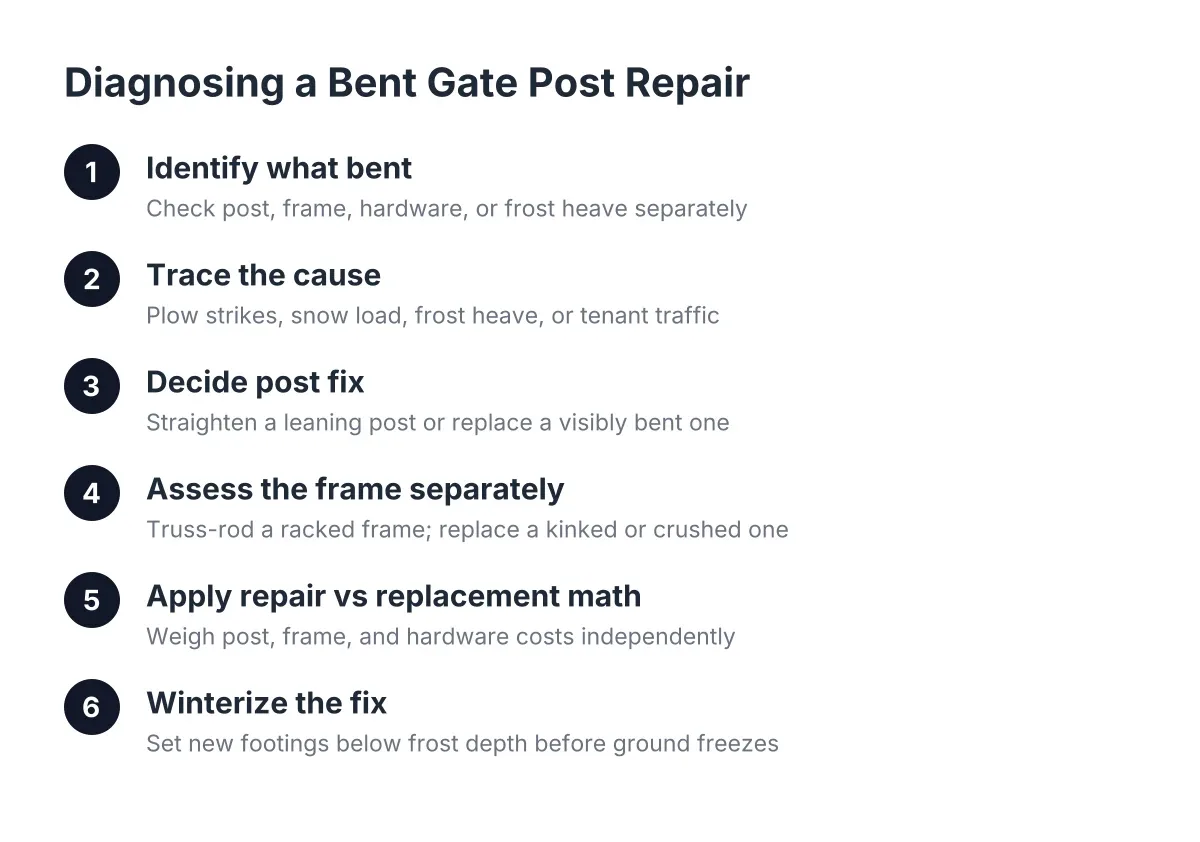
Step 1: Figure Out What Actually Bent, the Posts or the Frame
Before you order parts or request a fence estimate, identify which component failed. The post, the frame, and the hardware are three separate repairs with three different price tags.
Open the gate and look at it square on from a few feet back. Then check these points:
- The post is bent if the pipe itself curves or leans while the gate frame still looks square. Sight up the post like a rifle barrel; a bend shows fast.
- The frame is bent if the post stands straight but the gate itself is racked, twisted, or no longer a true rectangle. Measure both diagonals; if they differ, the frame is out of square.
- The hardware failed if post and frame are both straight but the gate sags. Loose hinge bolts and worn hinge pins mimic frame damage and cost far less to fix.
- The post heaved if it stands straight but sits higher or lower than it did last fall. That is frost movement, not impact damage, and it calls for a different fix.
In Anchorage, heaving is the imposter to watch for. Freeze-thaw cycles push footings up and tilt posts without bending any steel. A heaved post sometimes settles back; a bent one never does.
Step 2: Trace the Cause Before You Fix the Symptom
A repair that ignores the cause is a repair you pay for twice. This matters most on rental properties, where the same gate takes the same abuse every winter.
Common causes around Anchorage multi-unit sites:
- Plow and vehicle strikes. Dumpster trucks and snow plows clip gate posts in tight parking lots. If the bend is at bumper height, you have your answer.
- Snow load against the gate. Plowed berms shoved against a chain link gate will rack the frame over a winter. If frames bend every spring at the same corner of the lot, talk to your plow contractor about where the snow goes.
- Frost heave. Shallow footings move with the ground. A post that leans a little more each spring was likely set above the frost line.
- Tenant traffic. Gates that get climbed, swung on, or slammed hundreds of times a month wear out hinges first, then frames.
For example, suppose a manager takes over a 40-unit complex in Spenard and finds the dumpster enclosure gate dragging. The post looks bent at knee height. That pattern points to a truck strike, not frost, which means the fix is a post replacement plus a conversation with the hauler about clearance, not a deeper footing.
Step 3: Deciding Between Straightening and Replacing a Bent Gate Post
A bent steel post almost never gets straightened in place and stays straight. Galvanized pipe that has yielded once is weaker at the bend, and a gate hangs its full weight on that post every day. Cold-bending it back is a patch job of the kind that has you calling again in six months.
Use these rules of thumb:
- Minor lean, straight pipe: If the post itself is straight but tilted, the footing moved. The post can often be plumbed and re-set without buying new steel.
- Visible bend in the pipe: Replace the post. Hinge-side posts carry the gate's full weight, so a compromised hinge post is a liability issue, not a cosmetic one.
- Bend plus a cracked or shifted footing: Replace post and footing together, and set the new footing below frost depth so you are not repeating this in two years.
One cost-saver worth asking about: when the old footing is sound, a crew can sometimes cut the damaged post off and set a new post into or beside the existing concrete. That avoids demolition and keeps the repair bill down. Note that recently poured footings tend to grip posts harder than old ones, so removal difficulty varies, and the crew will make that call on site.
Timing matters in Anchorage. Setting a new post means digging below the frost line, and that work is far easier before the ground freezes. If a gate post bends in November, a temporary brace may carry it until spring digging season. A fence company that works here year-round can tell you which option fits the calendar.
Step 4: Assess the Gate Frame Separately
The frame has its own decision tree, and it is more forgiving than the post.
A racked frame, one that is out of square but not kinked, can sometimes be pulled back with a truss rod and turnbuckle. That is a legitimate fix for light sag, and it is cheap. However, a frame with a visible kink or crushed corner fitting will not hold adjustment. Replace it.
Here is the part that saves portfolio money: on a standard chain link gate, the frame and the posts are independent. A plow-struck gate frame can be swapped while the posts stay in the ground, and a bent post can be replaced while the original gate rehangs on it. You rarely pay for both unless both failed. Prefabricated replacement frames in standard widths keep this fast; custom widths take longer and cost more, which is a reason to standardize gate sizes across your properties when replacements come up.
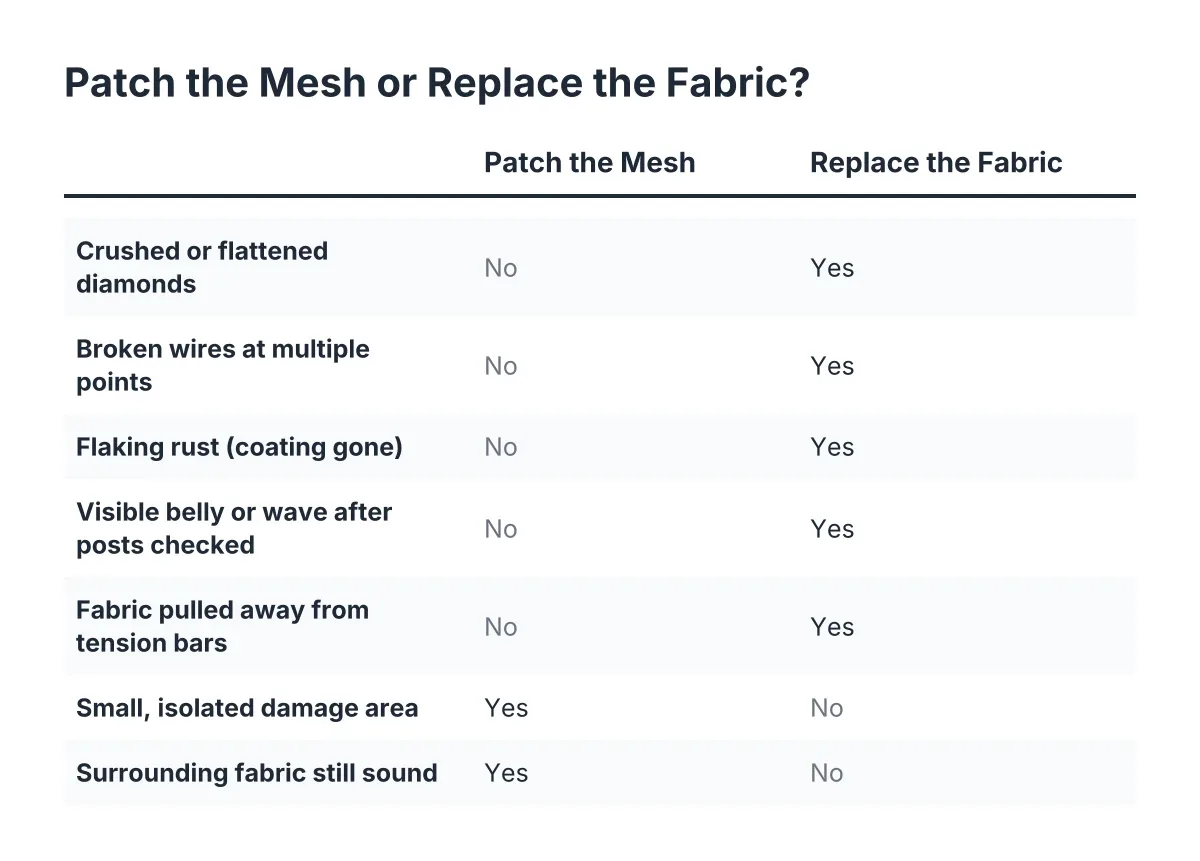
If the chain link fabric on the gate tore in the same incident, a repair roll covers it. A chain link fence repair roll is a short length of matching fabric that a crew weaves or ties in place of the damaged section, so the gate does not need all-new mesh. Matching the gauge and mesh size to your existing fence keeps the patch from standing out.
Step 5: Apply the Repair vs. Replacement Math
Now put the pieces together. As a working framework, not a quote:
- Hardware only: The cheapest outcome. New hinges, latch, or tension bands often solve a "broken gate" complaint outright.
- Frame only: Mid-range. Standard frames swap quickly, and the posts and footings stay put.
- Post only: Mid-range to higher, driven mostly by digging and concrete work. Winter ground conditions push this up.
- Post, footing, and frame together: This is where replacement of the whole gate assembly starts to beat piecemeal chain link fence repair, especially if the surrounding fabric and top rail also took damage.
Scale changes the math too. If three of your five properties have aging gates and one just failed, bundling the work into one mobilization usually costs less per gate than three emergency calls across two winters. A written scope per site also gives you clean documentation for the owner or asset manager who approves the budget.
Context for bigger decisions: chain link remains the budget option when replacement does come up. Chain link fencing averages $1,300 to $3,540 in total cost, compared to $1,790 to $4,560 for a comparable wood fence, according to Angi. That gap is one reason chain link stays the default for perimeters and enclosures on commercial sites.
Step 6: Make the Fix Survive the Next Anchorage Winter
A repaired gate should outlast the problem that broke it. Before you sign off on the work, confirm these items are in the scope:
- New or re-set posts go below frost depth, with footings shaped to resist heave.
- Hinge-side posts are sized for the gate's weight and width, not just matched to the line posts.
- Fence ties securing fabric to the frame are wrapped so they trap the mesh against the pipe; ties bent the wrong way work loose in wind.
- Gate swing and latch position account for snow accumulation, so the gate still opens in February.
- Plow operators know where the gates are and where the berms should not go.
One honest limitation: if a gate post failure involved a vehicle strike on a commercial property, or the fence serves a security or liability function, bring in a professional to inspect the full assembly before anyone rehangs the gate. Hidden footing damage and stressed rail connections are easy to miss from the surface, and a gate that fails a second time is a documented liability problem, not just a repair ticket.
The Short Version for a Busy Property Manager
Bent gate posts and frame damage are two different repairs, and knowing which one you have is most of the battle. Straight post with a crooked gate means frame or hardware. Bent pipe means post replacement, done below frost depth, ideally before freeze-up. Racked frames can sometimes be trued; kinked frames get replaced. Fix the cause, whether that is plow routing, snow storage, or shallow footings, and the same gate stops showing up in your work orders every spring.
If you need chain link fence repair, Anchorage Fence Co can help.
Prefer to talk it through? Call (907) 312-2862 — a quick call is usually the fastest way to get a straight answer for your situation.