Frost Line Depth for Fence Posts in Anchorage: What Wood Fence Installs Need
A wood fence in Anchorage lives or dies at the bottom of the post hole. Frost line depth for each post is the single factor that decides whether your fence stands straight for twenty years or starts jacking out of the ground by its second spring. Panels, pickets, and stain all matter less than what happens below grade. This guide explains how frost line fence posts perform when set correctly, what depth to plan around in Anchorage, how a proper footing gets built, and how to check that your installer did it right.
If you manage several rental properties, this is also the difference between one install and a recurring line item. A post set too shallow becomes a tenant complaint, then a repair call, then a replacement. Getting the footing right the first time is how you keep fence costs predictable across a portfolio.
Why Frost Heave Destroys Shallow Fence Posts
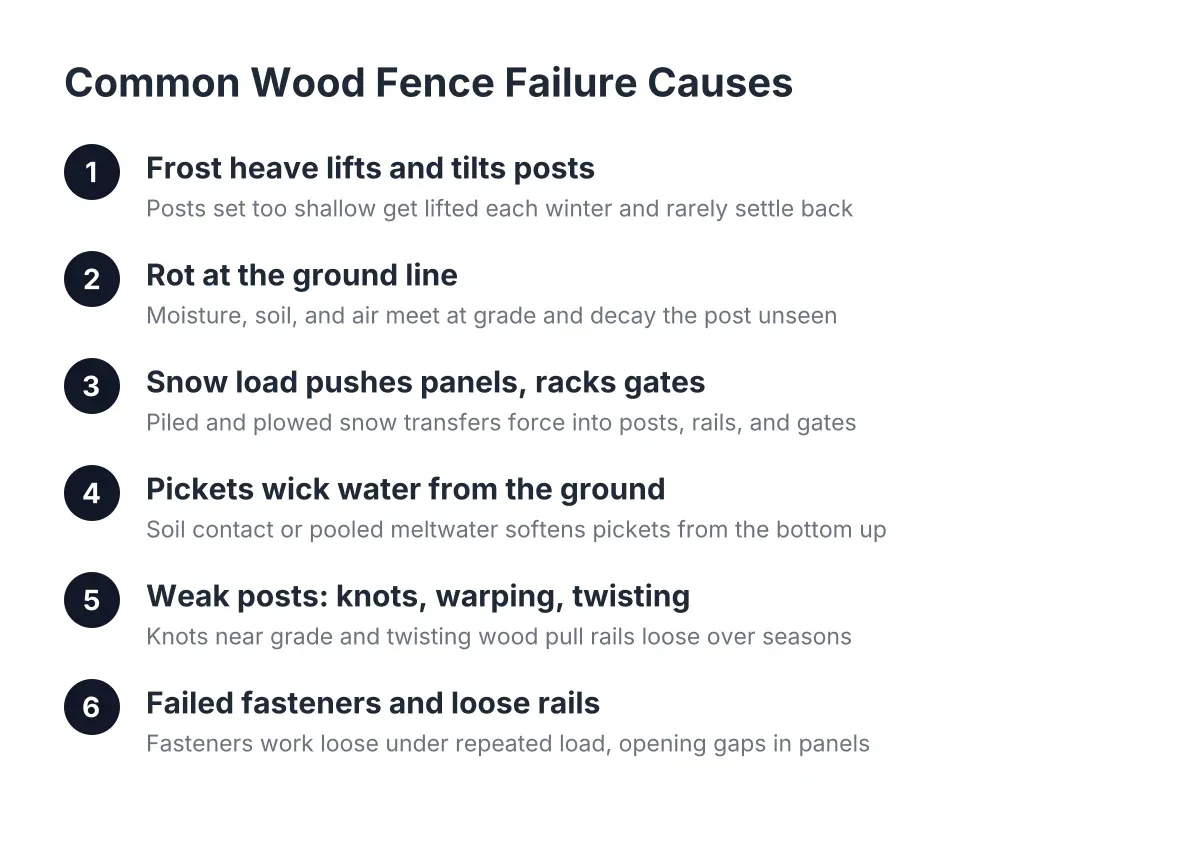
Frost heave is simple physics. Water in the soil freezes, and freezing water expands. When that expansion happens under or around a fence post, the frozen ground grips the post and lifts it. The ground thaws in spring, but the post rarely settles back to where it started. Soil slumps into the gap underneath, and the post stays high.
Repeat that cycle every winter and the damage compounds. A post might rise a little the first year, more the second, and by the third the fence line looks like a wave. Gates stop latching because the gate post and the latch post moved different amounts. Fence panels rack out of square, fasteners pull, and rails split.
Anchorage makes this worse than most places. Our freeze-thaw cycles are long and repeated, and the frost drives deep into the ground. Shoulder seasons bring multiple freeze-thaw swings in a single month. A post depth that works fine in a mild climate fails here, which is why national fence post depth charts are a poor guide for Southcentral Alaska.
The fix is not mysterious. Get the bottom of the footing below the depth where the ground freezes, and the frozen soil above has far less to grab and lift. That is the whole point of setting posts relative to the frost line.
How Deep Is the Frost Line in Anchorage?
Anchorage ground freezes deep, and local building standards reflect it. According to PermitsGuide.com, Anchorage's building code amendment sets the minimum exterior footing depth at 42 inches below finished grade as a frost-protection standard for footing and foundation work in the municipality. That figure is the clearest local benchmark for how seriously Anchorage treats frost depth.
Fence posts are not foundations, and fence footing requirements are not always identical to building footing requirements. Still, that 42-inch standard tells you what the municipality considers frost-safe depth for exterior concrete. A fence contractor planning frost line depth for posts in Anchorage should be working from that kind of local benchmark, not a generic national chart.
Actual frost penetration varies by site. Soil type, drainage, snow cover, and shade all change how deep the ground freezes on your specific lot. A wind-scoured, bare slope freezes deeper than a spot that holds an insulating blanket of snow all winter. Treat published depths as planning minimums, not maximums, and let the installer confirm depth for your ground.
Out in Knik-Fairview, Wasilla, and Meadow Lakes, conditions get more variable, not less. Undeveloped land, high water tables, and pockets of frost-susceptible silt are common. If you own acreage out there, ask your fence company directly how they handle frost line depth on post holes in unbuilt ground. A suburban-only installer who has never dug a pasture line in Valley soil is the wrong fit for that job.
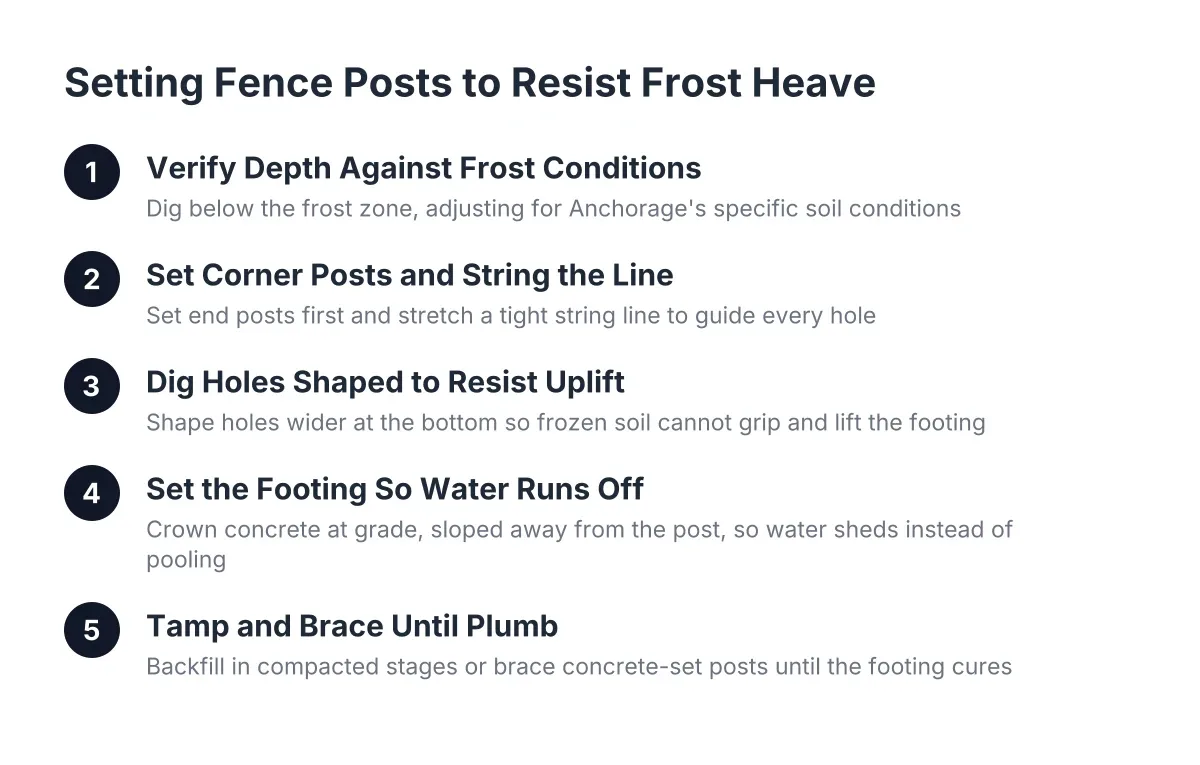
Setting Fence Posts Below the Frost Line
The bottom of a fence post footing should sit at or below the local frost depth, with the footing bearing on undisturbed soil. Stopping the hole an inch short of frost depth leaves the footing inside the freeze zone, which defeats the purpose. Most installers dig past the minimum rather than to it.
Depth alone is not the whole answer, though. The shape of the hole matters too. A hole that tapers wider at the top than the bottom, like a cone, gives frozen soil a shoulder to push against; the frost can lift the entire concrete plug like a cork. The hole should be a straight cylindrical shaft so the post gets consistent concrete thickness from top to bottom and the frost has nothing to grip.
Taller fences add a second requirement. An 8-foot privacy fence catches more wind and carries more snow load against its panels than a 4-foot picket fence, so its posts need both frost-safe depth and enough embedment to resist that leverage. On tall privacy fence runs, the structural rule of thumb and the frost rule both have to be satisfied, and the deeper of the two wins.
What a Proper Frost-Protected Post Footing Looks Like
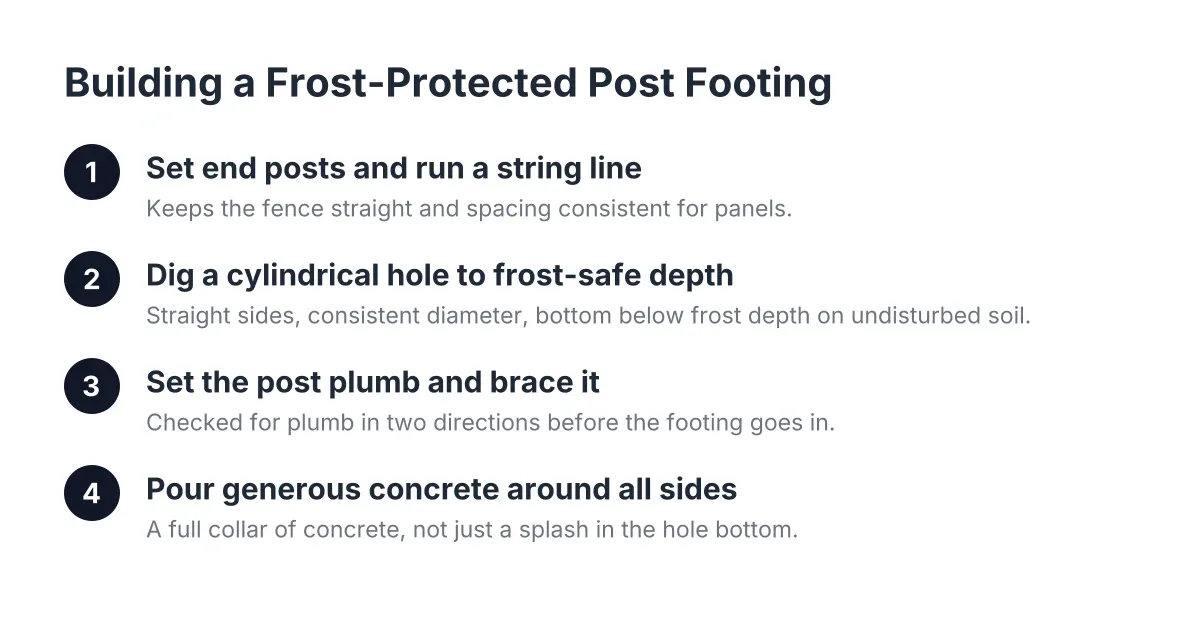
A post that lasts in Anchorage ground is not just a deep post. The footing around it has to be built right. Here is the sequence a careful crew follows on a wood fence installation, and what each step protects against:
- Set the end posts and run a string line. The crew sets posts at both ends of the run first, then stretches a tight string between them. Every hole gets dug to that line. This keeps the fence straight and keeps spacing consistent for the fence panels.
- Dig a cylindrical hole to frost-safe depth. Straight sides, consistent diameter, bottom below frost depth on undisturbed soil. No cone-shaped holes, no stopping early when the digging gets hard.
- Set the post plumb and brace it. The post gets checked for plumb in two directions and held there while the footing goes in. A post that starts out of plumb only gets worse under snow load.
- Pour generous concrete around all sides. The post needs a full collar of concrete, not a splash in the bottom of the hole. Thin spots in the footing are where movement starts.
- Stop the concrete short of grade and cap with soil. The top of the footing sits below ground level and gets covered with topsoil. Grass grows right up to the post, the footing stays hidden, and the finished fence looks like it belongs in the yard.
- Backfill and tamp in firm stages. Where soil backfill is used above the footing, it goes in a few inches at a time with thorough tamping between lifts. Loose backfill is the main reason posts work loose under wind and water over the years.
One practice to reject outright: tamping dirt back into the hole with no concrete or foam footing at all. That is not an acceptable way to set a structural fence post in this climate. It may hold a post upright through the first summer, but it gives frost heave and snow load nothing to fight back with.
A quick field check worth knowing: if a driven post still sticks up above the planned height after the crew tries to drive it down, it was not set deep enough. On a dug-and-poured install, the equivalent red flag is a crew that "runs out of hole" and trims posts instead of digging deeper.
Checking Post Depth as a Property Manager or Acreage Owner
You do not need to stand over every hole, but you should verify the work at a few points. For a property manager coordinating fence installation across multiple sites, a short checklist beats hoping the crew got it right.
- Before the job: Ask the fence company to state the post hole depth and footing method in the fence estimate. "Set below frost depth in concrete" should be written down, not assumed. Get the same scope language on every property so bids are comparable.
- During digging: Holes should look like straight shafts, not funnels. If you visit the site, a tape measure dropped in a hole settles the depth question in ten seconds.
- During the pour: Concrete should surround the post on all sides and stop a few inches below grade. Posts should be braced plumb until the concrete sets.
- After the job: Walk the line. Sight down the fence from one end; it should read straight against the string-line layout. Gates should swing and latch without force.
Suppose you manage a twelve-unit complex in Midtown Anchorage and inherit a cedar fence from a previous owner. Say the posts were set shallow in dirt, a common shortcut. In that scenario, you would expect a heaved post or a dragging gate complaint after each hard winter, and each handyman fix would hold about six months. Compare that with specifying frost-depth concrete footings on the replacement. The upfront wood fence cost runs higher, but the repair calls stop, and you budget one fence per property instead of one repair per season.
There is a middle path worth knowing about too. If the concrete footings on an existing fence are sound and only the wood posts have failed, an interim post repair that preserves those footings can keep the fence standing now. That repair cost effectively rolls toward a future full replacement, which matters when you are phasing fence work across a portfolio.
For acreage owners, scale changes the math but not the standard. A 600-foot perimeter line in Meadow Lakes has a lot of post holes, and every one of them needs the same frost-safe depth as a backyard fence in town. Shortcuts multiplied across hundreds of feet of fence become expensive fast when sections start leaning before the livestock even test them.
Does Post Depth Change With Fence Height and Type?
Yes. Frost depth sets the floor for every post, but fence height, material, and exposure can push the requirement deeper. A frost-safe depth for a 4-foot chain link fence is not automatically enough embedment for an 8-foot cedar privacy fence on a windy lot.
Height matters because of leverage. The taller the fence, the longer the lever arm that wind and drifted snow push against, and the more the post below grade has to resist. Solid privacy fence panels catch the full force of the wind; an open chain link fence or ornamental fence lets most of it pass through. Gate posts work hardest of all, since they carry a swinging load plus frost and wind, and they often get larger footings than line posts.
Local rules also cap how tall you can build in the first place. The Municipality of Anchorage sets front-yard residential fence height limits at 4 feet in most zones, rising to 6 feet, or 8 feet for non-sight-obscuring fencing like chain link, in R-6, R-8, and R-9 districts. Check your zone before pricing an 8-foot privacy fence, because height drives both the permit question and the post spec.
Difficult spots call for adapted details rather than skipped ones. Where a post has to butt against an existing fence or work around a tree, a reinforced post built on a metal pipe with sleeves can carry the load where a standard set will not fit. The principle stays the same: every post gets a real footing, even the awkward ones.
Budget-wise, footing depth is one reason material choice shifts total cost more than most people expect. According to Angi, installing a wood fence typically costs 20% to 30% more than a comparably sized chain link fence. For long perimeter runs on acreage, HomeGuide puts chain link at $10 to $40 per linear foot installed on average. Those are national 2026 figures, not Anchorage quotes; Alaska labor, access, and digging conditions move real numbers, so treat them as comparison points when you weigh wood against chain link for a given property.
Timing the Dig: Why Anchorage Fence Season Is Short
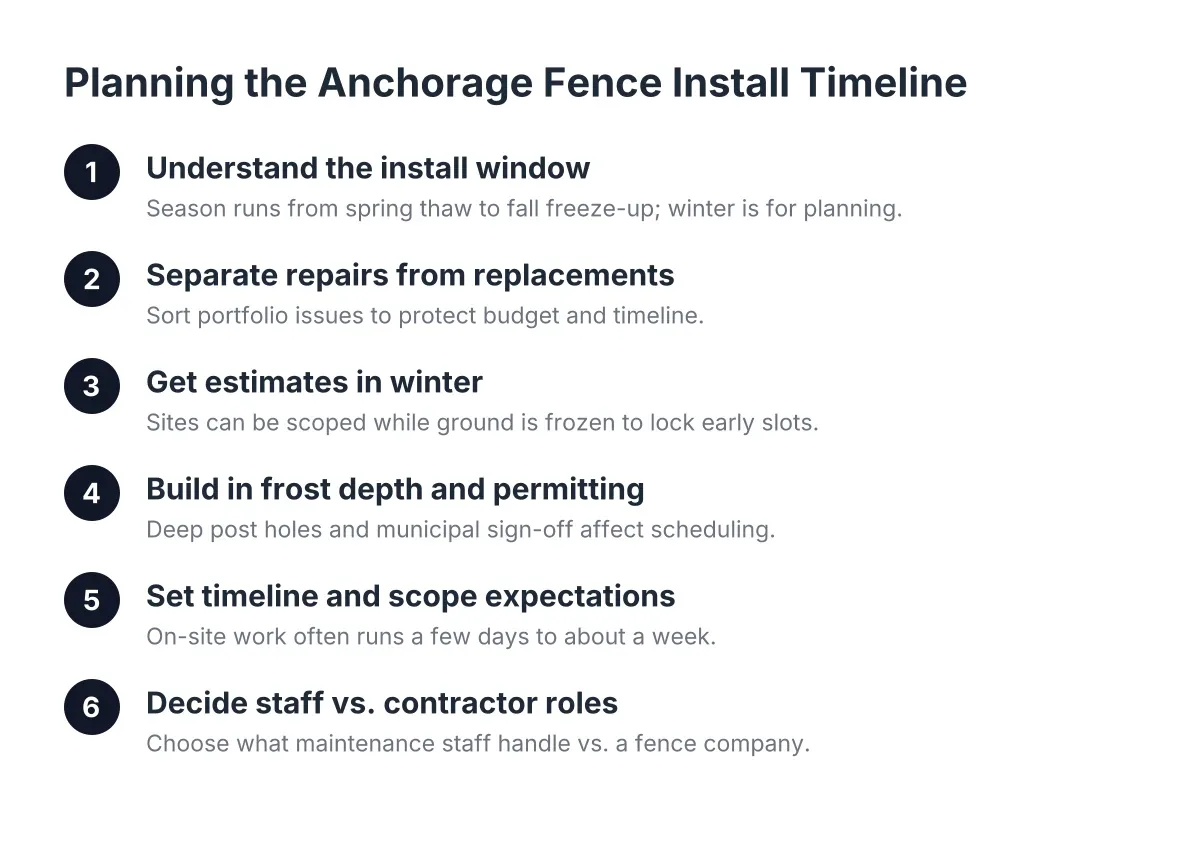
Frost depth does not just dictate how deep you dig. It dictates when you can dig at all. Once the ground freezes hard in late fall, hand and machine digging to frost-safe depth gets slow, expensive, or impossible until breakup. Anchorage's long dark winters compress the practical install season into a window that fills up fast.
Therefore, plan backward from winter. A property manager who gets fence complaints in October is usually scheduling repairs for spring, not getting new posts set before snow. The better rhythm is to walk your fence lines in late winter, scope repairs and replacements at breakup, and get on an installer's schedule before the summer rush.
Acreage owners face the same clock with higher stakes. If you need pasture fencing up before animals arrive, or you are replacing moose-damaged sections before snow, the dig has to happen while the ground is workable. Waiting until September to start a 1,000-foot line is how projects end up half-finished under the first snowfall.
One honest limitation: no footing method makes frost heave impossible in every soil. Sites with high water tables, frost-susceptible silts, or permafrost pockets in the Valley can move even well-set posts, and those sites deserve a professional assessment before anyone commits to a layout or a price. If your lot has standing water in spring or a history of heaved slabs and steps, say so when you request a fence estimate.
The Bottom Line on Post Depth in Anchorage
Everything above the ground is carpentry. Everything below the ground is what makes a fence an Anchorage fence. Frost line fence posts installed at the correct depth is the spec that separates a fence built for this climate from one that just looks right on install day.
Keep the core rules in view. Get the footing bottom below local frost depth, with Anchorage's 42-inch exterior footing standard as the local reference point per PermitsGuide.com. Insist on cylindrical holes, full concrete collars, firm tamping, and footings capped below grade. Reject dirt-only post setting. Match embedment to fence height and wind exposure, not just to frost. And schedule the dig while the ground still lets you.
For a property manager, written footing specs turn fence work from a recurring headache into a line item you control. For an acreage owner, they are the difference between a perimeter that holds livestock for decades and one you rebuild in sections every few years. Either way, the question to ask any fence company is the same: how deep do the posts go, and what holds them there.
If you need wood fence installation, Anchorage Fence Co can help.
Prefer to talk it through? Call (907) 312-2862 — a quick call is usually the fastest way to get a straight answer for your situation.